



* This page is still a work in progress. We update it regularly, so please check back.
* We are working to make this site easy to read.
Men's Rhythmic Gymnastics Rules
Chapter 1 Competition Rules
1 General Provisions
Article 1 Purpose of These Rules
Under Chapter 7 of the Articles of Endowment of the Japan Gymnastics Association (a public interest incorporated foundation), these rules serve as the guidelines of the Men's Rhythmic Gymnastics Committee for organizing and running competitions, and for organizing, training and certifying judges.
Article 2 Amendment of These Rules
These rules are amended by a majority vote of the Men's Rhythmic Gymnastics Committee.
2 Organization of Competitions
Article 3 Types of Competitions
[All Japan Championships] Every year, the "All Japan Rhythmic Gymnastics Championships" are organized for men and for women. The Japan Gymnastics Association entrusts their organization to one member organization. [National Sports Festival] The rhythmic gymnastics events of the National Sports Festival are organized in the same way as the All Japan Championships. [International Competitions] The Association may organize international competitions when it considers it appropriate. The concrete plan for organizing and running such a competition is drafted by the Men's Rhythmic Gymnastics Committee in accordance with the FIG regulations and approved by the Board of Directors of the Association.
Article 4 Competition Venues
Competitions organized under the supervision of the Association must be held in a place suited to their purpose (a gymnasium or an arena).
3 Running Competitions
Article 5 Responsibilities of the Organizing Association
The organizing association bears full responsibility, including for the Organizing Committee it forms. It bears all costs of publicity and organization, including the following. 1. Printing and sending the necessary booklets and printed materials 2. Preparing medals and certificates 3. Arranging the competition and training halls, and preparing enough official equipment for training and competition 4. Preparing the audio equipment needed for the accompanying music 5. Preparing the sound system needed to run the competition 6. Securing the staff needed for the competition to run smoothly, especially for displaying and communicating scores 7. Calculating results, announcing results during the competition and the final results, and preparing documents for the press. The Organizing Committee provides the judges with the information they need and supports their work. In general, the Organizing Committee keeps in close contact with the Men's Rhythmic Gymnastics Committee and handles the necessary matters.
Article 6 Entries
Entries are made on the form that the Association's secretariat sends to each member organization at the specified time, or on the form posted on the website. 1. One copy of the specified entry form must be submitted to the Association's secretariat by the specified deadline. 2. When preparing the final list of gymnasts, the registration number, name, date of birth and home prefecture of each gymnast, and their registration as a member of a member organization, must be confirmed. 3. If a gymnast needs to be changed after the entry has been submitted, the change must be submitted in writing to the Organizing Committee by the day before the competition and confirmed at the team managers' meeting. After the team managers' meeting, only gymnasts who were entered may be substituted.
Article 7 Creation of Compulsory Routines
When a competition with compulsory routines is held, the routines are created by the Men's Rhythmic Gymnastics Committee and communicated precisely to the member organizations in the Association's official terminology 12 months before the competition. Videos or diagrams of the routines may be made as aids to the explanation; if their content is problematic, the official written explanation or the official video of the Men's Rhythmic Gymnastics Committee prevails.
Article 8 Matters Not Covered by the Competition Rules or the Code of Points
Matters not covered by the competition rules or the Code of Points are decided by the Jury President, who serves on behalf of the Men's Rhythmic Gymnastics Committee, together with the judging panel. No protest may be made against such decisions.
Article 9 Flags and Club Flags
Each team may display one team flag (club flag), no larger than 4 m². It must be displayed where the Organizing Committee designates.
Article 10 Selection of the Judging Panel
At competitions organized by the Association, judges are selected from the official list prepared by the Japan Gymnastics Association. The Jury President and the chief judges defined in the Code of Points are appointed by the Men's Rhythmic Gymnastics Committee. Details of the judging panel are set out in Article 6 of Chapter 2, Code of Points.
Article 11 Appointment of the Competition Director
The Competition Director is appointed after consultation between the Men's Rhythmic Gymnastics Committee and the Organizing Committee, and, under the direction of the Jury President, supervises all assistants in the competition hall, the records section and the public relations section. The Venue Manager is appointed in the same way as the Competition Director and oversees the equipment and all facilities of the competition and training halls and their condition.
Article 12 Duties of the Judging Panel, the Competition Director and the Venue Manager
The Jury President, the judges, the Competition Director and the Venue Manager must devote themselves entirely to the duties above, and may not coach a team, take part in the competition or accept any other role under any pretext. The Jury President, the judges and the team managers concerned gather at the competition hall one hour before the start of the competition and are informed of the order of the competition and any temporary changes.
Article 13 Establishment of the Appeals Jury
An Appeals Jury is set up for each competition. It deals with any problems that arise during or after the competition, and consists of the President of the Association or one officer of the Board of Directors, the Jury President, the chief judges, and the Competition Director or their representative.
Article 14 Decisions of the Appeals Jury
Decisions of the judging panel and the Appeals Jury are final and cannot be changed, except in the case of a material error.
Article 15 Display of Final Scores
The Organizing Committee installs equipment that can show the final scores to the public and the gymnasts. All matters concerning scoring at the competition, especially the composition of the judging panel, the duties of the chief judges, the scoring of routines, and the judges at the start and during the competition, follow the Code of Points.
Article 16 Preparation of Audio Equipment
The Organizing Committee must prepare audio equipment for playing the accompanying music.
Article 17 Judges' Meeting and Team Managers' Meeting
The Organizing Committee holds a judges' meeting and a team managers' meeting the day before or two days before the competition. At these meetings, the order of performance of the teams and individuals, decided in advance by draw, is approved, and final instructions for the smooth running of the competition are given.
Article 18 Copies of Score Sheets and Complete Records
Copies of the score sheets are given to each team as soon as possible after each routine. At the end of the competition, each team receives a copy of the final results. Results are announced progressively during the competition, and the final results are announced after the competition ends. A duplicate of the complete records is kept in the Association's archives.
Article 19 Competition Hall and Floor Area
The competition hall must have a competition area of about 50 m × 30 m and a height of at least 12 m. Only people involved in the competition may enter the competition area. The floor area is 13 m × 13 m (inside measurement), surrounded by a safety zone of at least 2 m. If a podium is used, the safety zone must be at least 3 m. If two floor areas (men's and women's) are set up, they must be at least 4 m apart. The judges are seated at least 4 m from the floor area.
Article 20 Preparation of Equipment
All equipment is prepared by the Organizing Committee, which must follow the equipment certification rules and the instructions of the Men's Rhythmic Gymnastics Committee.
4 Competitions
Article 21 Competition Guidelines
Each competition is held according to the competition guidelines set for that year.
Article 22 Competition Schedule and Draw for the Order of Performance
The Men's Rhythmic Gymnastics Committee draws up the detailed competition schedule, sets the order of performance by a fair draw, and forms the judging panel.
Article 23 Competition Formats
Competitions are divided into two parts, group routines and individual routines, and are held in one of the following formats. 1. Group competition a. Competition I (e.g. All Japan Championships) [Events] A. Qualification (free routine) B. Final (free routine) [Ranking] The top 8 teams by score qualify for the final. Teams are ranked by the sum of half the qualification score and the final score (maximum 30 points). (See Article 28.) b. Competition II [Events and order] A. Qualification (compulsory routine) B. Final (free routine) [Ranking] The top 8 teams by score qualify for the final. Teams are ranked by the sum (maximum 30 points) of the qualification score (execution, 10 points) and the final score (maximum 20 points). (See Article 28.) Rankings for the compulsory and free routines are decided by the score of each event. c. Competition III (e.g. All Japan Group Championships, Inter-High School Championships, National High School Selection Championships) [Events and order] A. Final (free routine) [Ranking] Teams are ranked by the final score (maximum 20 points). (See Article 28.) 2. Individual competition a. Competition I (e.g. All Japan Championships, Intercollegiate Championships) [Events and order] A. Individual all-around (free routines) B. Apparatus finals (free routines) a. Stick b. Ring c. Rope d. Club [Ranking] The all-around is ranked by the total of the four apparatus (maximum 80 points). The top 8 gymnasts on each apparatus qualify for the apparatus finals, which are ranked by the final score (maximum 20 points). b. Competition II (e.g. All Japan Junior Championships, National High School Selection Championships) [Events and order] A. Individual all-around (free routines) B. Apparatus rankings (free routines) a. Stick b. Ring c. Rope d. Club The order of the apparatus is set in the competition guidelines. [Ranking] The all-around is ranked by the total of the four apparatus (maximum 80 points). Each apparatus is ranked by its score (maximum 20 points). c. Competition III (e.g. All Japan Youth Championships) [Events and order] A. Individual all-around (free routines) a. Stick b. Ring c. Rope d. Club [Ranking] The top gymnasts on two designated apparatus advance to the final and perform on the remaining two apparatus. Gymnasts are ranked by the total of their apparatus scores (maximum 20 points each). The designated apparatus and the number of finalists are set in the competition guidelines. 3. Combined group and individual competition a. Competition I (e.g. National Sports Festival) [Events and order] A. Individual competition a. Stick b. Ring c. Rope d. Club B. Group competition Four of the gymnasts entered in the group competition each perform one of the apparatus a to d. b. Ranking Teams are ranked by the sum of one quarter of the total of the four individual apparatus (maximum 20 points) and the group score (maximum 20 points).
Article 24 Entries for the Group Competition
Up to 8 gymnasts may be entered in the group competition. Six of the gymnasts approved at the team managers' meeting perform the group routine. A group may also perform with five or four gymnasts.
Article 25 Entries for the Individual Competition
Gymnasts may be entered in the individual competition as set for that year's competition. 1. The individual competition is held as Competition I, II or III. 2. Gymnasts who compete in the individual competition may also compete in their organization's group competition. 3. Gymnasts cannot be substituted after entry. 4. As a rule, each organization may enter up to 8 gymnasts in the individual competition.
Article 26 Use of Audio Equipment
The accompanying music is played on audio equipment. 1. Gymnasts may use the audio equipment prepared by the Organizing Committee or their own. 2. Music media must be labeled with the organization's name or the gymnast's name. 3. For compulsory routines, the music issued by the Association may be used.
Article 27 Faulty Audio Equipment
If the Jury President and the Competition Director agree that the audio equipment was faulty, the routine may be repeated without deduction in both the group and the individual competition.
Article 28 Ranking
In all competitions, rankings are decided by the scores obtained. 1. Scores are totaled according to the ranking method of each competition. 2. Teams and gymnasts who qualify from the qualification to the final must compete in the final. Those who do not compete in the final are disqualified and lose all awards of the competition, except in cases of force majeure or for reasons accepted as legitimate. 3. In the individual competition, when the top 8 gymnasts qualify for an apparatus final, no more than three gymnasts from the same organization may qualify. 4. If a place in the final becomes vacant, it is filled by the next-ranked team or gymnast. 5. The order of performance in the final is decided by draw in two groups: 1st to 4th and 5th to 8th. [Breaking ties] Tied scores share the same rank, but priority for the final or for a higher-level competition is decided as follows. a. Group competition i. The team with the higher total of all judges' scores (including the chief judges, the highest and lowest scores, and deductions). ii. If still tied, the team with the higher total of all composition judges' scores. iii. If still tied, the team with the higher total of the chief judges' scores. iv. If still tied, by draw. b. Individual competition For the all-around, all apparatus performed in the qualification are considered; for apparatus titles, only that apparatus is considered, as follows. i. The gymnast with the higher total of all judges' scores (including the chief judges, the highest and lowest scores, and deductions). ii. If still tied, the gymnast with the higher total of all composition judges' scores. iii. If still tied, the gymnast with the higher total of the chief judges' scores. iv. If still tied, by draw. c. National Sports Festival and its regional qualifiers i. The team with the higher group competition score (the original score). ii. If still tied, the team with the higher total of all judges' scores (including the chief judges and the highest and lowest scores) in the group competition and the four individual apparatus. iii. If still tied, the team with the higher total of all judges' scores (including the chief judges and the highest and lowest scores) in the group competition. iv. If still tied, by draw.
Article 29 Organizations and Team Managers
Each organization taking part in a competition must have one team manager for the whole competition.
Article 30 Illness or Accident During a Routine
If a gymnast becomes ill or has an accident during a routine, the Jury President must be informed immediately through the team manager, the routine must be stopped, and the gymnast must be examined by a doctor.
Article 31 Access to the Competition Hall
Access to the competition hall is limited to the Jury President, the Competition Director, the judges, the gymnasts and team managers, the music operators, the judges' assistants, and the staff essential for the audio equipment and for the routines. Other people may enter the competition hall with permission, provided they do not interfere with the smooth running of the competition. Special seats are provided for the following people. 1. Presidents of the participating member organizations 2. Reserve judges 3. Assistant judges 4. Gymnasts and team managers who are not about to perform
5 Awards
Article 32 Award Ceremony
Results are honored and awards presented at a formal ceremony attended by all gymnasts (representatives of each member organization), the judging panel, the Organizing Committee and the public.
Article 33 Awards at Championships
At championships, medals and certificates are presented to the placing teams and individuals, and all gymnasts and judges receive a participation award. 1. Group championship Teams are ranked by the scores of Competition I, II or III. The first-place team is honored as the champion team, and each member of the team receives a gold medal. Certificates are presented to the top 8 teams. 2. Group event championships Teams are ranked by the score of each routine, compulsory and free. The first-place team in each event is honored as the champion team, and each member receives a gold medal. In the same way, each member of the second-place team receives a silver medal and each member of the third-place team a bronze medal. Certificates are presented to the top 6 teams. 3. Individual all-around championship Gymnasts are ranked by the scores of Competition I, II or III. The first-place gymnast is honored as the national champion and receives a gold medal. The second-place gymnast receives a silver medal and the third-place gymnast a bronze medal. Certificates are presented to the top 8 gymnasts. 4. Individual apparatus championships Gymnasts are ranked by the score of the apparatus final or of each apparatus. The first-place gymnast on each apparatus is honored as the champion and receives a gold medal. The second-place gymnast receives a silver medal and the third-place gymnast a bronze medal. Certificates are presented to the top 6 gymnasts.
6 Gymnasts
Article 34 Unpaid Membership Fees
Member organizations with unpaid membership fees and unregistered gymnasts may not take part in competitions organized by the Association.
Article 35 Eligibility and Amateur Rules
Only amateurs as defined by the Association's amateur rules are accepted as gymnasts at competitions held under the supervision of the Association.
Article 36 Age
Gymnasts must be at least 12 years old in the year of the competition (as of April 2) and be registered members of a member organization of the Association. Gymnasts aged 11 or younger may compete only if approved by the Association under the responsibility of their federation.
Article 37 Duties of Gymnasts
A gymnast's first duty is to perform at the competition, and a gymnast may not accept any other role until this duty has been fulfilled.
Article 38 Events a Gymnast May Enter
Gymnasts may compete in both the group and the individual competition.
Article 39 Gymnasts' Attire
Gymnasts wear a close-fitting gymnastics top and gymnastics trousers, with no skin showing except on the head, face, neck, hands and arms. Any color may be used, but the fabric must be opaque. Decorative sequins are allowed if they are securely attached. The organization's emblem must be worn on the front of the upper body or on the upper arm where the judges can see it. 1. Gymnastics top a. The top may have sleeves and a collar or not, but it must be close-fitting. b. If the neck is open, any shape is allowed, but the inner edge of the cut must be at the sides of the neck, and the front and back openings must not go below the line joining the armpits. c. The top must be tucked into the trousers. 2. Gymnastics trousers a. Straight trousers must pass under the arch of the foot and be neatly finished. b. Flared trousers must be close-fitting down to the knees. The width of the hem must not exceed the length of the foot. A deduction is applied if the hems become untidy. 3. The emblem may be any color, but it must be distinguishable from the color of the competition attire. It must be at least as large as one of the following shapes. a. A 4.5 cm × 4.5 cm square b. A 4.0 cm × 5.0 cm rectangle c. An equilateral triangle with 5.0 cm sides d. A circle 4.5 cm in diameter e. A rhombus with 4.0 cm sides and angles of 60° and 120° 4. In the group competition, all gymnasts must wear attire of the same design and color with the same emblem. 5. Gymnasts must perform in gymnastics shoes or socks, which may be any color.
Article 40 Rights of Gymnasts
Gymnasts are guaranteed the following rights. 1. Their routines are scored accurately and fairly according to the Code of Points. 2. They may take part in official training at the venue and perform on a carefully prepared floor. 3. Their scores are displayed promptly after the routine, or published according to the rules of the competition. 4. They may repeat the whole routine if it was interrupted for a reason not caused by the gymnast, or by force majeure recognized by the Appeals Jury. 5. They may receive all their scores at the competition from the organizer as official results.
Article 41 Discipline of Gymnasts
Gymnasts must strictly observe the following rules. 1. Gymnasts and judges must trust and respect each other. 2. Gymnasts must know the competition rules and the Code of Points well and behave as befits a gymnast. 3. Gymnasts must accept the results of scoring under the Code of Points. 4. Gymnasts may enter the floor area only after being called by the announcer or the chief judge, and must enter promptly once called. 5. Gymnasts must leave the floor area promptly after their routine. 6. Gymnasts must not warm up anywhere in the competition hall other than the designated areas. 7. Gymnasts must not speak to the judges during a routine. 8. Gymnasts must not behave in an undisciplined or rough manner or disturb other gymnasts. 9. Gymnasts must not deliberately give verbal cues or talk during a routine. 10. Gymnasts must not show an attitude of giving up during a routine. 11. Gymnasts must not behave offensively toward the audience in the competition area.
7 Team Managers and Coaches
Article 42 Duties and Discipline of Team Managers and Coaches
So that the competition runs smoothly, team managers and coaches must observe good manners and ethics and strictly follow the rules below. 1. Team managers are fully responsible for their gymnasts and must give the instructions needed for the competition to run smoothly. 2. Team managers must attend the team managers' meeting held before the competition. 3. Team managers are responsible for passing on the content of the team managers' meeting to their gymnasts and others concerned. 4. Team managers must strictly follow the competition rules so that the competition runs smoothly. 5. Team managers may not stand on the floor area. 6. Team managers must not interfere with a gymnast during a routine except in an emergency. 7. Team managers must not behave offensively toward the audience or officials in the competition area. 8. Team managers may ask the Jury President about questions regarding scores, but must not protest directly to individual judges.
Article 43 Violations of Discipline
If a gymnast, team manager or coach violates the rules of discipline, a deduction or other penalty may be imposed under the Code of Points.
8 General Competition Rules
Article 44 Rhythmic Gymnastics Routines
A men's rhythmic gymnastics routine combines free-hand elements and tumbling elements. In the group competition it expresses the synchronization and power of six gymnasts, and in the individual competition it expresses handling suited to the character of each of the four apparatus, while moving the body to its limits. A routine must contain all the elements required in each competition, have high technical value, a variety of elements, a good relationship between music and movement, and originality, and every movement must be performed rationally and with stability.
Article 45 Accompanying Music
1. All routines must be performed to accompanying music. 2. The music must be characterized by good tone and melody. It must suit the character of the routine, have a clear, continuous rhythm and be in harmony with the rhythm of the gymnasts' movements. 3. The music must be played on instruments (including synthesizers) or sung by the human voice. 4. The music is played from recorded media. If the competition guidelines specify otherwise, those instructions apply. 5. No music may be played while gymnasts enter or leave the floor area. 6. If the music stops for a reason for which the organizers are not responsible, as a rule the routine may not be repeated.
Article 46 Scores
1. Free routines are scored out of 20 points: composition (D) out of 10 points and execution (E) out of 10 points. Compulsory routines are scored for execution (E) out of 10 points. 2. The highest and lowest scores of the four judges, excluding the chief judge, are dropped, and the average of the counting scores is calculated to three decimal places, truncating the fourth. If the chief judge applies a deduction, it is subtracted from that score to give the final score.
Article 47 Duration of the Routine
The duration of every routine is set as below. In the group competition, it is measured from the moment at least one gymnast starts moving until all gymnasts have completely stopped. In the individual competition, it is measured from the moment the gymnast starts moving until the gymnast has completely stopped. 1. Group competition: 2 min 45 s to 3 min 00 s 2. Individual competition: 1 min 15 s to 1 min 30 s
Article 48 Number of Gymnasts in a Group
A group routine is performed by six gymnasts. A group may also compete with five or four gymnasts, but a deduction is applied.
9 Apparatus
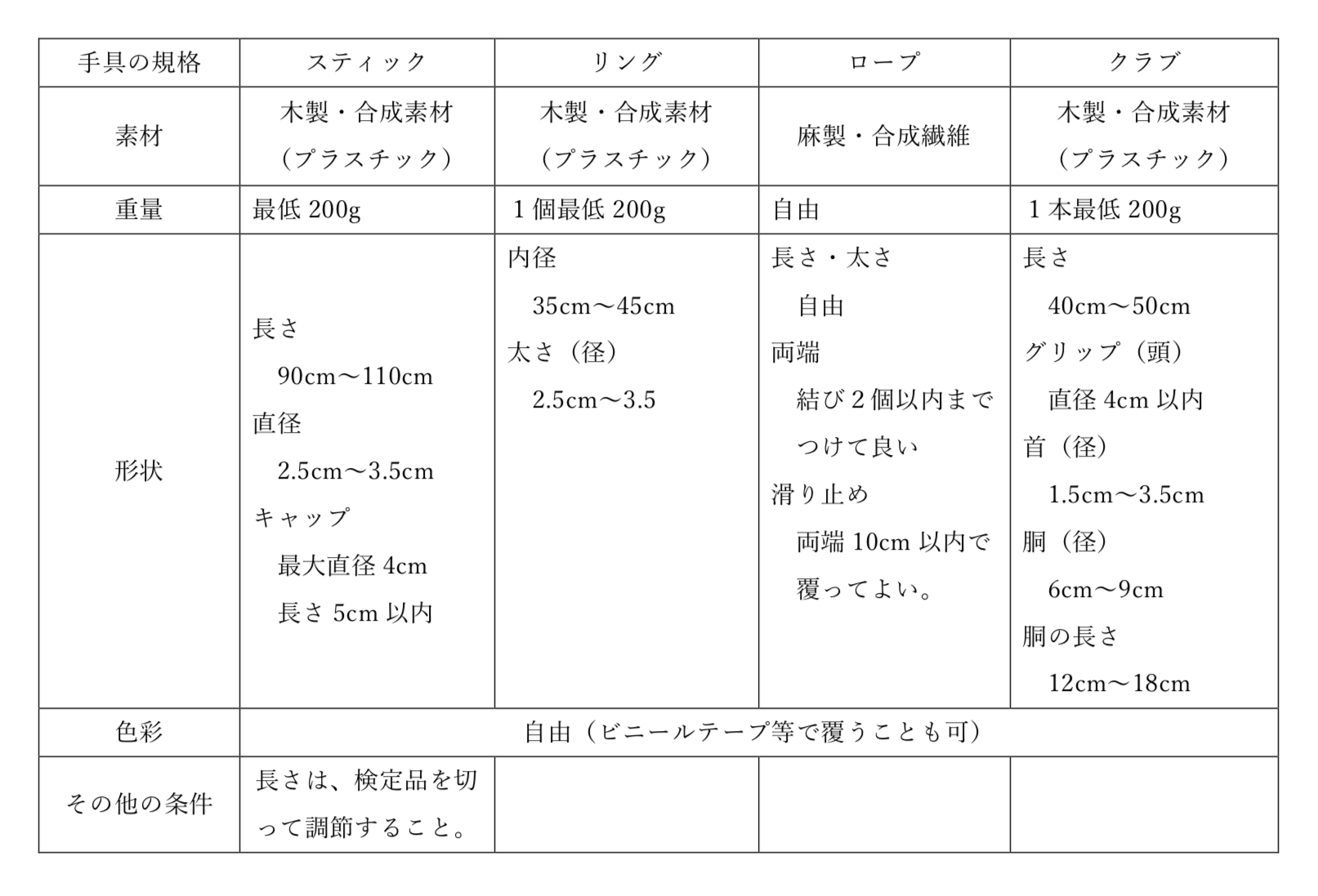
Article 49 Apparatus Specifications
Equipment and apparatus used in competition must meet the certified specifications of the Japan Gymnastics Association. * For juniors, see the rules for juniors.
Article 50 Apparatus Inspection
1. Apparatus are inspected before the competition. Only apparatus that pass the inspection, including spare apparatus, may be used in the competition. 2. Apparatus that pass are marked with a sticker prepared by the Organizing Committee. 3. The stickers are checked just before gymnasts enter the competition hall. 4. If the Jury President or the chief judge concerned requests it, the apparatus may be inspected again after the routine. 5. Even certified apparatus may be judged out of specification at the inspection if they have deteriorated.
Article 51 Matters Not Covered by the Competition Rules
All matters of judging and scoring not covered by these rules follow the Code of Points.
Chapter 2 Code of Points
1 General Provisions
Article 1 Application of the Code of Points
1. The Code of Points is used to judge international and national competitions by common standards and to make their evaluation objective. 2. It serves to improve the ability of judges and their scoring technique, and guides gymnasts and coaches in their training for competition. 3. Judges must strictly observe these rules. Judges who do not may be replaced by the Jury President.
2 Judging
Article 2 Competition and Judging
1. Rhythmic gymnastics is a judged sport, so the judges set its direction and guide its development. Their responsibility is therefore very great. 2. Judges must have a broad perspective, sound judgment and deep experience, and must be conscientious and fair. 3. Given their special authority and position, judges must fully understand the routines performed before them and judge them correctly. 4. Judges need the ability to observe and understand everything: the quality of execution, the difficulty and value of the movements in the composition, their harmony with the accompanying music, and so on. 5. Besides technical progress, judges must also assess harmonious flexibility and masculine power. 6. Judges must judge by their own convictions, without being influenced by the audience's applause or by showy routines of no value. 7. Unfair or wrong judgments not only greatly affect coaches and gymnasts but also hinder the spread of rhythmic gymnastics.
Article 3 Regulations for Judges
1. At competitions held under the supervision of the Association, judging is done by judges certified under the regulations for certified judges. 2. The Jury President and the judges must devote themselves to their duties and may not coach a team, take part in the competition or accept any other role under any pretext. 3. Judges must carry out their duties at the competition hall throughout the competition to which they are appointed. 4. Judges must never be influenced in their scoring. 5. Judges must attend the judges' meeting and the judges' training session before the competition; those who do not may not serve. 6. Every judge is fully responsible for their own scores. 7. Judges must always behave professionally, without prejudice, in an ethical and exemplary manner. 8. The Jury President and the judges gather at the competition hall one hour before the start of the competition and are informed of the order of the competition and any temporary changes. 9. Judges carry out their duties in the prescribed attire. a. Gray trousers b. Navy blue jacket c. White shirt d. Tie e. Judge's badge
Article 4 Judges' Training Sessions and Judges' Meetings
1. At the judges' meeting and training session, compulsory routines are reviewed with the official written explanation or the official video, and free routines are reviewed thoroughly for the quality of composition and execution, so that the focus of scoring is made clear. 2. Judges found to be insufficiently capable at the judges' meeting may be removed from the competition.
Article 5 Judges' Oath
Judges solemnly take the following oath. "As a judge, I promise to act only in the spirit of sporting dignity and integrity, and to judge the routines performed conscientiously, without regard to the person or the organization."
Article 6 Composition of the Judging Panel
1. As a rule, the judging panel of a competition consists of men. 2. As a rule, the judging panel consists of the Superior Jury, the Jury President, and, for each event, a composition panel and an execution panel, each with one chief judge and four judges, as well as two line judges, one timekeeper and reserve judges. 3. At competitions with a qualification and a final, the judges switch events and switch between composition and execution.
Article 7 Superior Jury
The Superior Jury carries out the following duties under its internal rules. 1. Supervising the competition and dealing with violations and special situations that affect the running of the competition. 2. Taking the necessary action when one or more judges make a serious judging error. 3. Continuously reviewing the scores given by the judges and warning judges whose work seems inadequate or unfair. 4. Removing and replacing judges if a warning does not lead to a satisfactory result.
Article 8 Jury President
1. The Jury President is appointed by the Men's Rhythmic Gymnastics Committee. 2. The Jury President convenes the judges at the set time and place and makes all decisions necessary for the smooth running of scoring and the preparation of results. 3. The Jury President may remove from the competition judges found to be insufficiently capable at the judges' meeting. 4. The Jury President may intervene with the judges at any time during the competition. After hearing the chief judge's opinion, the Jury President may remove and replace judges who do not act correctly and satisfactorily.
Article 9 Chief Judges
1. The chief judge scores every routine on the panel they lead, but the chief judge's score is not included in the calculation. 2. The chief judge carefully checks the scores submitted by each judge. If a score breaks the rules or the scores are inconsistent, the chief judge shows their own score and discusses it with the judges. 3. After the first gymnast, the chief judge calls the judges together if necessary to agree on a common starting point. 4. The chief judge takes part in the decisions of the Appeals Jury. 5. If the chief judge applies a deduction, it is subtracted from the average of the counting scores to determine the final score.
Article 10 Composition (D/A) Judges
Composition judges assess the compositional value of the routine performed and score it out of 10 points.
Article 11 Execution (E) Judges
Execution judges assess the quality of the routine performed and score it out of 10 points.
Article 12 Line Judges
Line judges sit at the corners of the floor area and judge whether the gymnast's body or apparatus goes out of bounds. They signal each violation with a red flag and, after the routine, report the number of violations and the deductions to the execution chief judge.
Article 13 Timekeeper
The timekeeper measures the following times and reports them to the composition chief judge. 1. The time from entering the floor area to the start of the routine 2. The time from the start to the end of the routine
Article 14 Reserve Judges
Reserve judges assist with the judging work and replace judges in an emergency. [Superior Jury] The Superior Jury consists of the head of the Judges' Department and the FIG Technical Committee member (nominated by the JGA). If necessary, one expert designated by the Judges' Department (a member of the department or an experienced judge) may be added (two or three members in total). The head of the Superior Jury is chosen by the members from among themselves. The duties of the Superior Jury are: 1. Supervising the competition and dealing with violations and special situations that affect the running of the competition 2. Taking the necessary action when one or more judges make a serious judging error 3. Continuously reviewing the scores given by the judges and warning judges whose work seems inadequate or unfair 4. Removing and replacing judges if a warning does not lead to a satisfactory result [Appeals Jury] Internal rules The Appeals Jury consists of two members of the Board of Directors (one of whom serves as its head) and one member of the Judges' Department who is not involved in scoring, or an expert judge nominated by the Judges' Department (three members in total). The members from the Board of Directors are nominated by the Board, and the member from the Judges' Department is nominated by the department concerned. The duties of the Appeals Jury are: 1. After the competition, at an appropriate time, the Appeals Jury handles petitions from judges who were warned or removed by the Superior Jury. 2. The Appeals Jury also monitors whether the statutes, the competition rules, and the rules and guidelines are observed. In the case of a violation, it reports to the body responsible for sanctions.
3 General Scoring Rules
Article 15 Scoring Method and Score Ranges
1. Judges score from 0 to 10 points in steps of one twentieth of a point. 2. With a chief judge and four judges For composition and execution separately, the highest and lowest scores of the judges other than the chief judge are dropped, the average of the counting scores is calculated (truncated after the third decimal place), and the two averages are added. If the chief judge applies a deduction, it is subtracted from this total. 3. When the chief judge also serves as one of the judges For composition and execution separately, the highest and lowest scores of the four judges including the chief judge are dropped, the average of the counting scores is calculated (truncated after the third decimal place), and the two averages are added. If the chief judge applies a deduction, it is subtracted from this total. 4. The range of the counting scores must not exceed the following. 5. The range between the highest and lowest scores of all judges must not exceed the following.
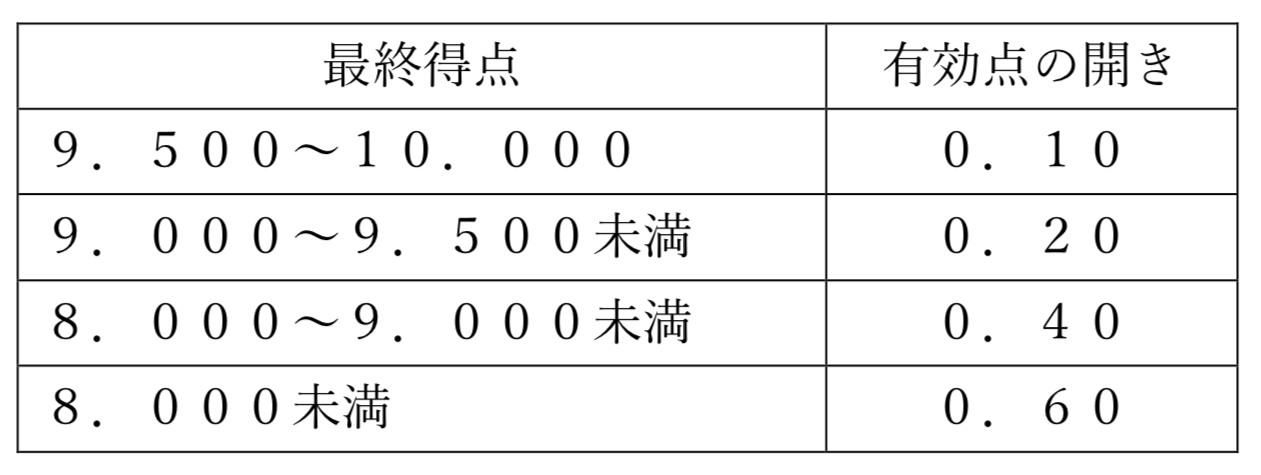
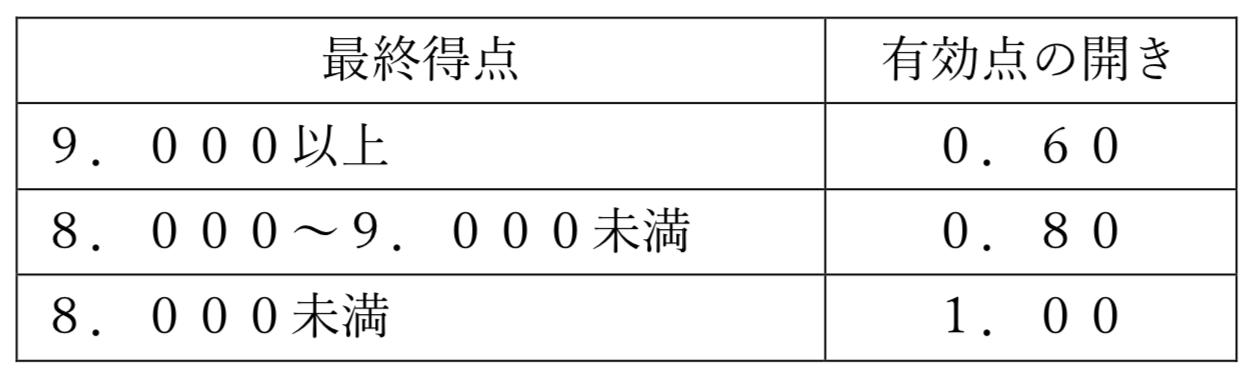
Article 16 Base Score
The base score is used when the judges and the chief judge cannot resolve a problem even after discussing it together. It is calculated as follows. (Average of the counting scores + chief judge's score) / 2 = base score
Article 17 Duration of the Routine
1. If the duration in Article 47 of the competition rules is not respected, a deduction is applied whether the routine is too long or too short. [Deduction by the composition chief judge: 0.005 points per second] 2. If the routine is shorter than the following, the score is as follows. Group competition: 2 min 30 s Individual competition: 1 min 00 s [Score: 0.00 points for both composition and execution]
Article 18 Time Before the Start of the Routine
A deduction is applied if the time from entering the floor area to the start of the routine exceeds the following. Group competition: 30 s Individual competition: 20 s [Deduction by the execution chief judge: 0.20 points]
Article 19 Entering and Leaving the Floor Area
Gymnasts must enter and leave the floor area promptly, walking or running. [Violation: deduction by the execution judges, 0.20 points]
Article 20 Out of Bounds
Out of bounds is treated as follows, and the deduction is applied by the execution chief judge. * In items 5 and 6, "each apparatus" means each of the two apparatus in a set. 1. Out of bounds means that part of the body or the apparatus touches the floor beyond the floor area. Crossing the line in the air is not penalized. 2. An apparatus held by the gymnast that crosses the line is treated as part of the body and penalized. 3. One foot, both feet or another part of the body crosses the line. [Deduction: 0.10 points each time] 4. In the group competition, several gymnasts cross the line at the same time. [Deduction: 0.10 points per gymnast] 5. An apparatus that has left the body crosses the line. [Deduction: 0.10 points per gymnast] 6. The body or apparatus crosses the line repeatedly because of a single error. [Deduction: 0.10 points each time for the body or for each apparatus]
Article 21 Competition Attire
Violations concerning competition attire are penalized as follows. 1. Violation of Article 39 of the competition rules (including the emblem). Slight differences in printed patterns are not penalized. [Deduction by the composition chief judge: 0.20 points per gymnast] 2. Performing in torn attire. Attire torn during the routine is not penalized. [Deduction by the execution judges: 0.10 points per gymnast] 3. Attire that becomes badly disordered. [Deduction by the execution judges: 0.10 points per gymnast]
Article 22 Accompanying Music
Under Article 45 of the competition rules, deductions 1 to 4 are applied. 1. No accompanying music. [Deduction by the composition chief judge: 0.50 points] 2. Music played while entering or leaving the floor area. [Deduction by the composition chief judge: 0.20 points] 3. A pause of 3 seconds or more in the music. [Deduction by the composition judges: 0.20 points] 4. If the music stops for a reason for which the organizers are not responsible, as a rule the routine may not be repeated. If the music stops, the Jury President and the Competition Director promptly determine the cause and deal with it.
Article 23 Apparatus
1. If an apparatus breaks during the routine, the gymnast must replace it. 2. Going out of bounds to replace the apparatus is not penalized. 3. An interruption to replace the apparatus is penalized as an interruption of the routine. [Deduction by the execution judges: 0.10 points per second] 4. If the apparatus is not replaced after it breaks, the rest of the routine after the break is scored as having no value. 5. If the apparatus breaks at the end of the routine, the routine is treated as having ended without the gymnast touching the apparatus. 6. A routine in which the apparatus broke may not be repeated. 7. Use of an apparatus that does not meet the specifications [Score: 0.00 points for both composition and execution] 8. Use of a spare apparatus [Deduction by the composition chief judge: 0.50 points]
Article 24 Discipline
1. A gymnast violates Article 41 of the competition rules. [Deduction by the execution judges: 0.20 points] 2. If a team manager violates Article 42 of the competition rules, a strict warning is given and the deduction or penalty is decided. [Deduction by the execution chief judge: 0.20 points]
4 Group Competition
1 Scoring of the Group Competition (Free Routine)
Article 25 Scoring Criteria and Points for the Group (Free Routine)
The points and scoring criteria for the free routine are as follows.
group.png)
group.png)
2 Composition (D/A)
Article 26 Too Few Gymnasts
If the number of gymnasts is below six, the following applies. 1. A group with fewer than four gymnasts may not compete. 1. A group with four or five gymnasts [Deduction by the composition chief judge: 1.50 points per missing gymnast]
Article 27 Requirements for the Composition
A routine is composed of free-hand elements and tumbling elements, and must have high technical value, a variety of elements, a good relationship between music and movement, and originality. All movements must be combined rationally and with stability, and the routine must contain a large amount of movement.
Article 28 Difficulty Requirements
1. Value of difficulty elements Gymnasts must have complete control of their bodies in competition, so a routine requires power, beauty and stability suited to the gymnasts' ability. 2. Value and level of difficulty elements A group routine must include the following difficulties. [Violation: deductions Each missing B difficulty: 0.10 points Each missing C difficulty: 0.30 points Each missing D difficulty: 0.50 points] * Difficulties beyond the required number can be counted as difficulties of a lower rank.
requirement.png)
Article 29 Free-Hand Requirements
A routine must include all the basic free-hand element groups 1 to 5. Groups 2 to 5 can be counted as difficulty elements, but they must be performed by all gymnasts, either at the same time or one after another. Static positions must be held by all gymnasts at the same time. 1. A basic free-hand element group is missing entirely. [Deduction: 1.00 point per group] 2. A basic free-hand element group is incomplete. [Deduction: 0.20 points per gymnast] * Incomplete means that some gymnasts did not perform it. Holding a static position too briefly or insufficient flexibility is penalized in execution.
requirement.png)
Article 30 Types of Tumbling
Tumbling includes tumbling movements with their run-up, and partner and pyramid elements, and is classified into the following types. 1. Simultaneous elements All gymnasts start and finish the element at the same time. If several gymnasts continue with tumbling immediately after a simultaneous element, it is still treated as a simultaneous element. 2. Series Gymnasts perform tumbling one after another without a break, individually or in groups. 3. Crossing elements A gymnast tumbles over other gymnasts. 4. Partner and pyramid elements Gymnastics performed by two or more gymnasts together, using each other's bodies and strength. They count as tumbling from the moment one or more gymnasts make contact.
Article 31 Conditions for Tumbling
The following count as tumbling when performed in a routine. 1. One or more gymnasts perform a tumbling movement, once or in a series. 2. A partner or pyramid element is performed. 3. All gymnasts, divided into groups, perform the tumbling in (1) or (2) one after another without a break. 4. The run-up to a tumbling movement is accepted as part of the tumbling. 5. Rolling movements other than cartwheels (forward roll, backward roll, sideways roll, walkover) do not count as tumbling, but a forward or backward roll performed after a salto as a supporting movement is accepted as part of the tumbling. 6. A dive roll with a run-up of three or more steps (two-foot take-off), or a dive roll with a run-up of two steps or fewer (including a one-foot take-off) with an added twist.
Article 32 Tumbling Requirements
1. A routine must include four tumbling passes. [Violation: deduction 0.30 points] 2. A routine must include the basic tumbling element groups 1 and 2 below. Basic tumbling element group 3 may be included up to two times. [Violation: deduction 0.30 points] * A start from a partner or pyramid element or from contact is treated as group 3.
requirement.png)
Article 33 Restricted Elements
Article 34 Formation Requirements
A routine must include at least five different formations. [Violation: deduction 0.30 points]
Article 35 Start of the Routine
1. The routine may start anywhere on the floor area, but all gymnasts must take their positions, hold a starting pose and be still before starting. 2. Contact and partner or pyramid elements at the start of the routine are not treated as tumbling. They must be released within 3 seconds; if they last longer or include a salto, they count as tumbling.
Article 36 End of the Routine
1. The routine may end anywhere on the floor area, but all gymnasts must hold a final pose and stop moving completely. 2. Contact and partner or pyramid elements at the end of the routine are not treated as tumbling. They must be completed within 3 seconds of the movement leading into the final pose; if they last longer or include a salto, they count as tumbling.
Article 37 Scoring of Technical Value
The technical value of a routine is scored on the following points. [Number and level of difficulties] See Article 28. [Difficulty elements] 1. Difficulties performed with free-hand elements See Article 66. 2. Difficulties performed with tumbling elements See Article 67. [Combination of elements] 1. Technical value from combining movements The technical value of a routine also depends on how the movements are combined. 2. Uniformity of difficulty elements All gymnasts are required to perform the same technique or difficulties of the same value. 3. Distribution of difficulty elements Difficulty elements should be distributed evenly throughout the routine. 4. Stability of difficulty elements Difficulty elements must be chosen according to the gymnasts' ability.
Article 38 Scoring of Variety
The composition must give an impression of great variety in the following respects. 1. Variety of free-hand elements The routine must be rich in variety of free-hand movements and their combinations. 2. Variety of tumbling elements The routine must be rich in variety of tumbling elements, their types and their combinations. 3. Variety in the use of space The routine must use the whole floor area, with a variety of formations and movements across the floor, in their directions, sizes, paths and levels. 4. Variety of rhythm The movements must match the character and rhythm of the music exactly, and the changes of rhythm must be rich in variety. 5. Variety of dynamics Dynamics means the sense of power expressed by changes in speed and strength. The changes between fast and slow must be rich in variety.
Article 39 Scoring of the Relationship Between Music and Movement
The accompanying music for rhythmic gymnastics must be characterized by good tone and melody. The routine must match the character and rhythm of the music.
Article 40 Scoring of Originality
The composition must show originality, characterized by the pursuit of novelty and technical creativity, such as new techniques and new combinations.
Article 41 Composition Faults
Composition deductions not listed above follow the table below. Composition fault standards [Large fault: severely lacking Deduction 0.30 points] [Medium fault: lacking Deduction 0.20 points] [Small fault: slightly lacking Deduction 0.10 points] [Very small fault: very slightly lacking Deduction 0.05 points] Table of composition faults
kettenhyou.png)
3 Execution (E)
Article 42 Quality of the Routine
A routine must show overall harmony and stability in free-hand technique, tumbling technique and harmony with the accompanying music, and must be performed freely, giving an impression of continuity throughout. Execution that is light, beautiful and graceful, in time with the music, is required.
Article 43 Scoring of Body Movement Technique
Body movement technique is scored on the following points. 1. Free-hand technique Free-hand movements must be performed with beautiful posture and flexibility. Movements starting from the solar plexus must be natural, deep and large, with pauses and accents, height in jumps and changes of speed, and must be controlled to the tips of the limbs. 2. Tumbling technique Tumbling must be dynamic, with speed and height, an accurate axis of rotation and stable landings. 3. Rhythmic execution The routine must be performed lightly and expansively. 4. Individual and collective faults Individual and collective faults such as the following are penalized according to the table of execution faults. 5. Inaccurate posture or movement of an individual gymnast 6. Disorder in movements or formations
Article 44 Scoring of Overall Harmony
Overall harmony is scored on the following points. 1. Group synchronization From start to finish, identical and different movements must be combined with a sense of unity, and the execution must be harmonious and unified in amplitude, speed, rhythm and dynamics. 2. Harmony with the music 3. The music disturbs the routine [Deduction: 0.20 points] 4. The volume is excessively loud [Deduction: 0.20 points] 5. The final movement does not match the music [Deduction: 0.20 points] 6. Artistry and expression A routine requires artistic expression. Artistry means using body technique to express the theme of the music and the message of the composition to the audience, conveying it and moving them. 7. Hesitation by a gymnast or interruption of the routine [Deduction: 0.10 points per second]
Article 45 Prohibited Actions
Unnecessary body contact must not be made during the routine.
Article 46 Execution Faults
Execution deductions not listed above follow the table below. Execution fault standards [Large fault: severely lacking Deduction 0.30 points] [Medium fault: lacking Deduction 0.20 points] [Small fault: slightly lacking Deduction 0.10 points] [Very small fault: very slightly lacking Deduction 0.05 points] Table of execution faults Execution deductions for handstands, balances and flexibility
kettenhyou1.png)
kettenhyou2.png)
kettenhyou3.png)
5 Individual Competition
1 Points and Scoring Criteria
Article 47 Scoring Criteria and Points for the Individual Competition
The points and scoring criteria for the individual competition are as follows.
single.png)
single.png)
2 Composition (D/A)
Article 48 Composition of the Routine
A routine is composed of free-hand and tumbling elements with apparatus handling, and must have high technical value, a variety of elements, a good relationship between music and movement, and originality. All movements must be combined rationally and with stability, and the routine must contain a large amount of movement.
Article 49 Difficulty Requirements
An individual routine must include the following difficulties. Violation: deductions Each missing B difficulty: 0.10 points Each missing C difficulty: 0.30 points Each missing D difficulty: 0.50 points * Difficulties beyond the required number can be counted as difficulties of a lower rank.
Article 50 Free-Hand Requirements
A routine must include group 1 (various free-hand movements) of the basic free-hand element groups (Article 29). [Violation: deduction 0.30 points]
Article 51 Tumbling Requirements
A routine must include forward, backward and sideways tumbling. [Violation: deduction 0.30 points for each missing direction]
Article 52 Apparatus Handling Requirements
A routine must include all of the following basic elements for each apparatus. [Stick] 1. One throw with the left hand caught with the left hand 2. One throw with the right hand caught with the right hand 3. At least three throws, including 1 and 2 4. A roll of at least 1 m 5. Two propeller rotations [Missing elements: deduction 0.30 points each] [Ring] 1. A simultaneous throw of both rings 2. At least three throws, including 1 3. A roll of at least 1 m 4. Two spins [Missing elements: deduction 0.30 points each] [Rope] 1. At least three throws 2. A triple under 3. Consecutive jumps traveling at least 6 m 4. At least two consecutive forward jumps 5. At least two consecutive backward jumps [Missing elements: deduction 0.30 points each] [Club] 1. A simultaneous throw of both clubs 2. At least three throws, including 1 3. A roll of at least 50 cm 4. Two propeller rotations [Missing elements: deduction 0.30 points each]
Article 53 Apparatus Elements and Difficulty
[Throws] 1. A throw must rise at least 2 m from the point of release. Lower throws are not treated as throws. 2. A stick throw-and-catch element that is not caught is not counted as an element. 3. If the gymnast performs free-hand or tumbling elements during a throw and fails to catch the apparatus, it counts as a throw element but not as a throw-and-catch difficulty. However, in a simultaneous throw of two rings or two clubs, if only one apparatus is not caught, it counts as a throw difficulty. 4. A simultaneous throw of two apparatus may be made with one hand, both hands or the feet, and the catch is free. However, it is not accepted as an element if the two rings are joined together when thrown, or if one of the apparatus rises less than 2 m from the point of release. [Rolls] A roll that is too short is not counted as an element. [Rope jumps] Forward and backward jumps that are not performed twice in a row, and traveling jumps that cover too short a distance, are not counted as elements.
Article 54 Start of the Routine
The routine may start anywhere on the floor area, but the gymnast must take position touching the apparatus, hold a starting pose and be still before starting. [Violation: deduction 0.30 points]
Article 55 End of the Routine
The routine may end anywhere on the floor area, but the gymnast must hold a final pose touching the apparatus and stop moving completely. [Violation: deduction 0.30 points] If the gymnast leaves the floor area to retrieve the apparatus and does not hold a final pose: No ending: deduction by the composition judges, 0.30 points Interruption of the routine: deduction by the execution judges, 0.50 points Out of bounds: deduction by the execution chief judge, 0.20 points Total: 1.00 point
Article 56 Scoring of Technical Value
<Number and level of difficulties> See Article 49. [Difficulty elements] 1. Difficulties performed with free-hand elements: see Article 71. 2. Difficulties performed with tumbling elements: see Article 69. 3. Difficulties performed with throws and catches: see Article 70. [Combination of elements] 1. Technical value from combining movements The technical value of a routine also depends on the value of how the movements are combined. 2. Distribution of difficulty elements Difficulty elements should be distributed evenly throughout the routine. 3. Stability of difficulty elements Difficulty elements must be chosen according to the gymnast's ability. <Technical value of apparatus handling> [Balance between the left and right hands] As a harmonious whole, the apparatus must be handled with both the left and right hands, without favoring one. [Technical value of throws and catches] Throws and catches must be performed without stopping the flow of apparatus handling. Throws and catches with parts of the body other than the hands, and throws and catches outside the field of vision, can also be recognized as having high technical value.
Article 57 Scoring of Variety
1. Variety of free-hand elements The routine must be rich in variety of free-hand movements and their combinations. 2. Variety of tumbling elements The routine must be rich in variety of tumbling elements, their types and their combinations. 3. Variety of apparatus handling The routine must be rich in variety of apparatus handling and its combinations. (See the Appendix: routines with each apparatus.) 4. Variety in the use of space The routine must use the whole floor area, with a variety of movements across the floor, in their directions, sizes, paths and levels. 5. Variety of rhythm The movements must match the character and rhythm of the music exactly, and the changes of rhythm must be rich in variety. 6. Variety of dynamics Dynamics means the sense of power expressed by changes in speed and strength. The changes between fast and slow must be rich in variety.
Article 58 Scoring of the Relationship Between Music and Movement
The accompanying music for rhythmic gymnastics must be characterized by good tone and melody. The routine must match the character and rhythm of the music.
Article 59 Bonus
[Originality] The composition must show originality, characterized by the pursuit of novelty and technical creativity, such as new techniques and new combinations. A bonus is given to a composition recognized as original. An original composition includes, for example: 1. New elements (body movement elements, apparatus handling elements, tumbling elements or links between them) 2. Novelty in the relationship between the gymnast and the apparatus 3. New ways of performing existing elements 4. New combinations of existing elements [Bonus: 0.20 points] [Additional difficulty] The technical value of a routine is mainly determined by the level and number of difficulties and the value of their combinations. A bonus for this technical value is given in the following cases (1) to (4). 1. The composition includes four or more D difficulties. 2. Four or more free-hand or tumbling elements are combined during a throw, or a D difficulty throw and catch is performed with two apparatus thrown. 3. A D difficulty tumbling element performed while holding the apparatus includes a throw or two or more handlings. 4. The routine includes a throw or catch outside the field of vision, or a throw or catch with a part of the body other than the hands. [Bonus: 0.10 points per item]
Article 60 Composition Faults
Composition deductions not listed above follow the table below. Composition fault standards [Large fault: severely lacking Deduction 0.30 points] [Medium fault: lacking Deduction 0.20 points] [Small fault: slightly lacking Deduction 0.10 points] [Very small fault: very slightly lacking Deduction 0.05 points] Table of composition faults
kettenhyou(S).png)
3 Execution (E)
Article 61 Quality of the Routine
A routine must show overall harmony and stability in free-hand technique with apparatus handling, tumbling technique and harmony with the accompanying music, and must be performed freely, giving an impression of continuity throughout. Execution that is light, beautiful and graceful, in time with the music, is required.
Article 62 Scoring of Apparatus Handling Technique
[General technique] During the routine, the apparatus must always move naturally, using the momentum that comes from its own weight. The apparatus must not be stopped, except for static positions required by the routine. [Swinging technique] When the apparatus is swung or circled in the hand, as a rule it must be handled like an extension of the arm. [Throwing and catching technique] 1. Throwing the apparatus with the hand Except for special throws, as a rule the apparatus must be thrown using the swinging or circling technique. 2. Catching the apparatus The apparatus must be caught naturally, in time with its fall, at the part needed for the next handling, and the gymnast must move on to the next handling without stopping.
Article 63 Scoring of Body Movement Technique
Body movement technique is scored on the following points. 1. Free-hand technique Free-hand movements must be performed with beautiful posture and flexibility. Movements starting from the solar plexus must be natural, deep and large, with pauses and accents, height in jumps and changes of speed, and must be controlled to the tips of the limbs. 2. Tumbling technique Tumbling must be dynamic, with speed and height, an accurate axis of rotation and stable landings. 3. Rhythmic execution The routine must be performed lightly and expansively.
Article 64 Bonus
[Mastery and artistry] Mastery means that apparatus handling technique and body movement technique are controlled perfectly and simultaneously. Artistry means using these techniques to express the theme of the music and the message of the composition to the audience, conveying it and moving them. A bonus is given when the following are met. 1. The whole routine is performed without faults. 2. The whole routine is performed with perfect technique, ease and outstanding amplitude. 3. The theme of the music and the message of the composition are expressed perfectly. [Bonus: 0.10 points each] * "Without faults" here means that there are no faults in the table of execution faults in Article 65 other than those under "free-hand movement technique".
Article 65 Execution Faults
Execution deductions not listed above follow the table below. Execution fault standards [Large fault: severely lacking Deduction 0.30 points] [Medium fault: lacking Deduction 0.20 points] [Small fault: slightly lacking Deduction 0.10 points] [Very small fault: very slightly lacking Deduction 0.05 points] Table of execution faults
kettenhyou(S).png)
6 Difficulty
1 Difficulty Requirements
Article 66 Free-Hand Difficulties
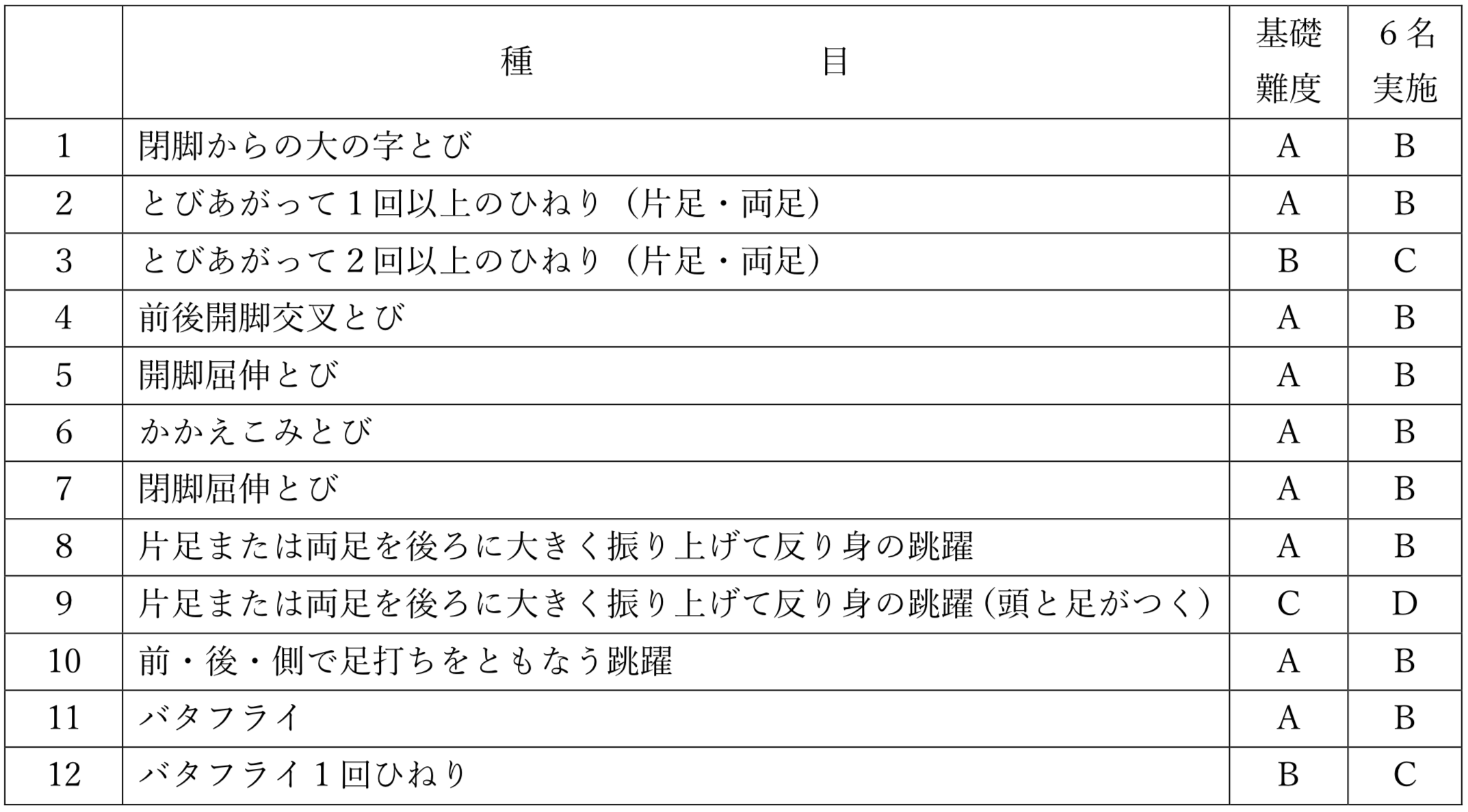
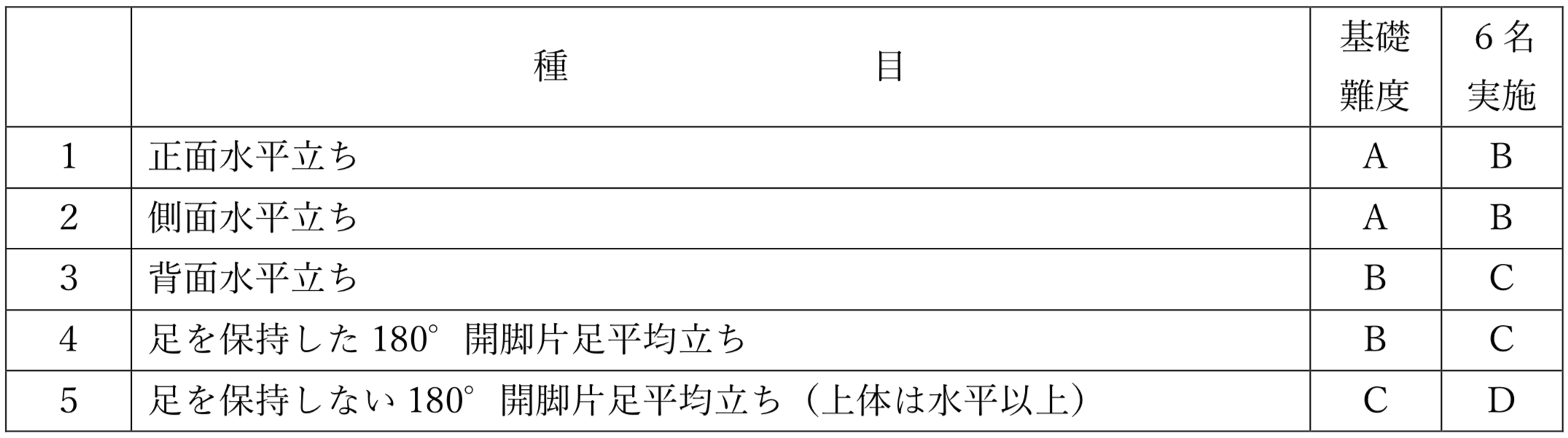
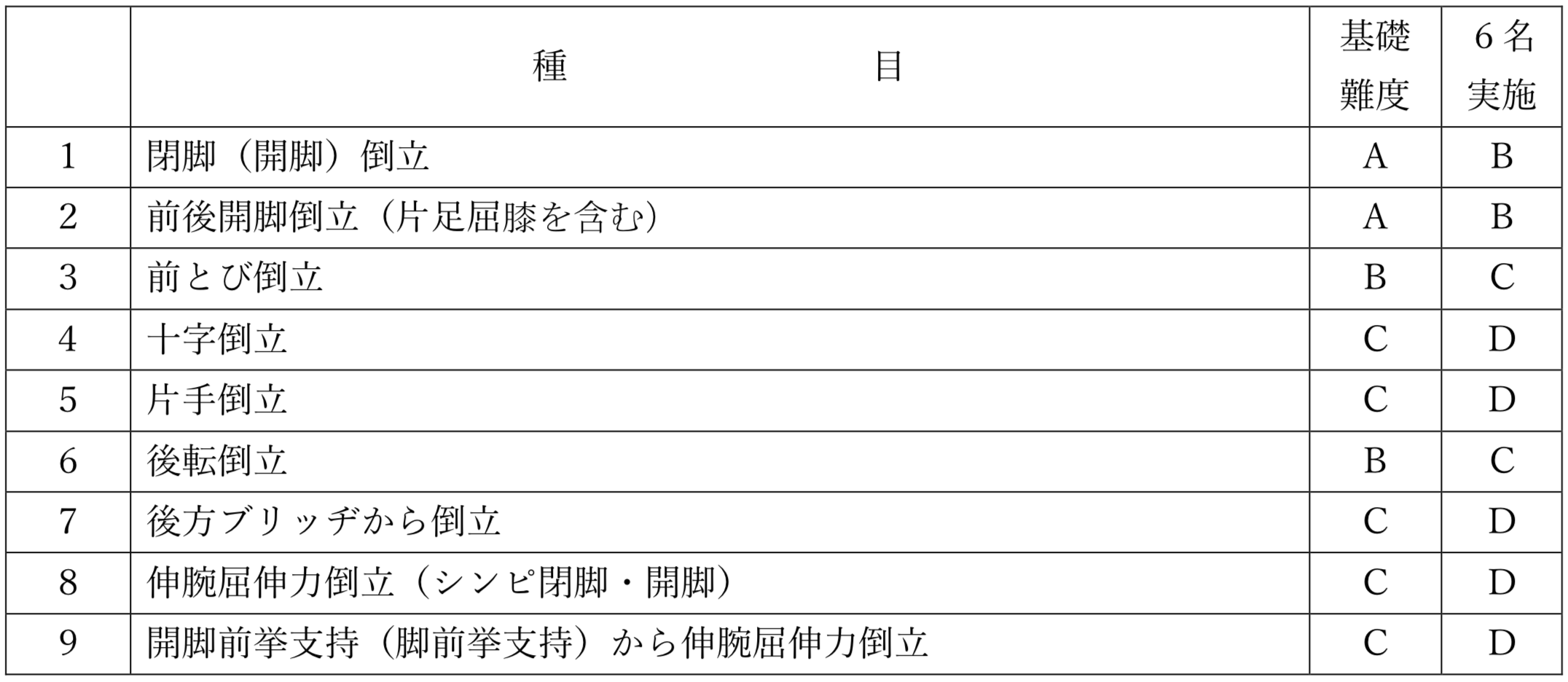
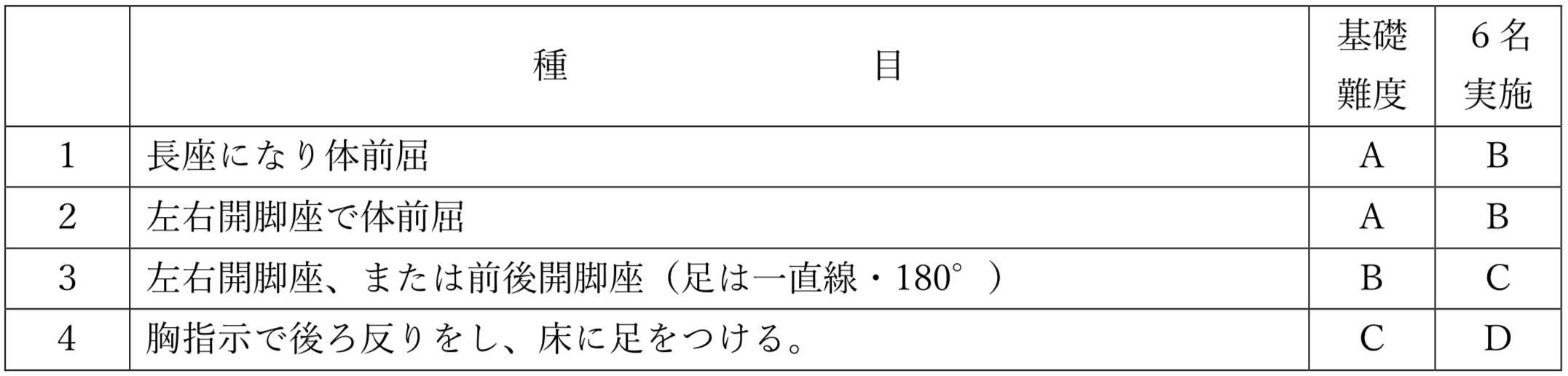
Free-hand difficulties are determined as follows. 1. In the individual competition, when performed with apparatus handling, the basic difficulty applies. 2. In the group competition, the basic difficulty applies when three to five gymnasts perform the element, and the six-gymnast difficulty applies when all six perform it. The element must be performed at the same time or one after another. a. When different elements of the same group (each of groups 1 to 4 below) are combined, combinations whose difficulty rises when performed by six gymnasts are upgraded if all six perform them. b. Combinations of elements from different groups are not counted as difficulties. c. Static positions of 2 seconds must be held at the same time. [Table of basic difficulties] Jumps, balances, handstands (held for 2 seconds) and flexibility A (static flexibility) are shown below.
2 Tumbling Difficulties
Article 67 Tumbling Difficulties
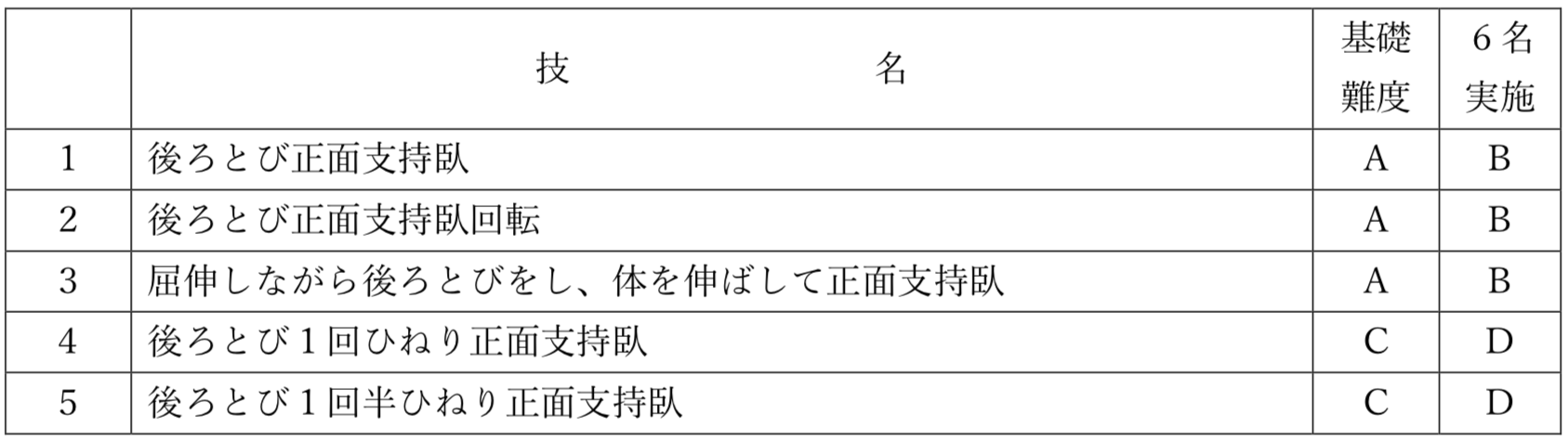
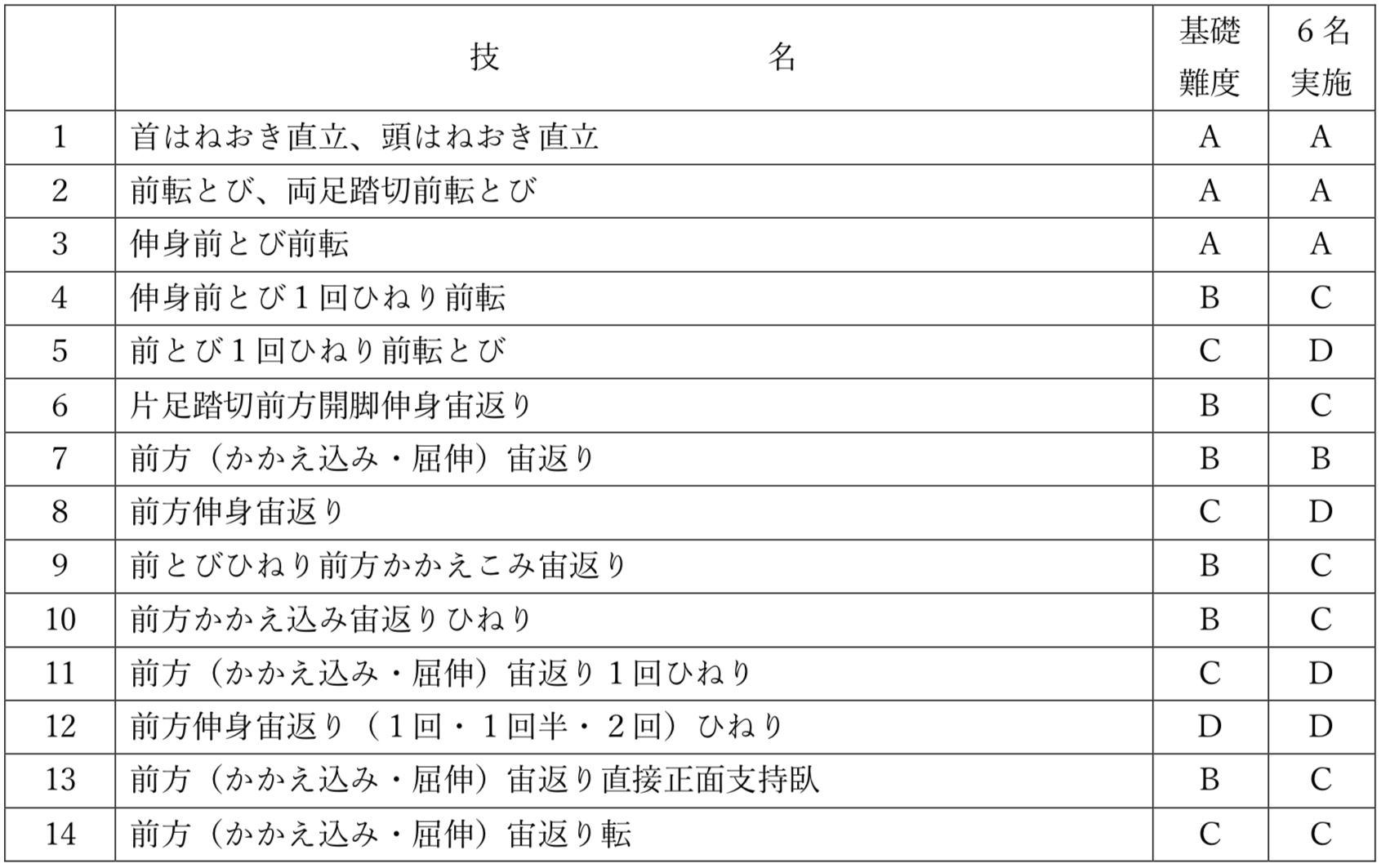
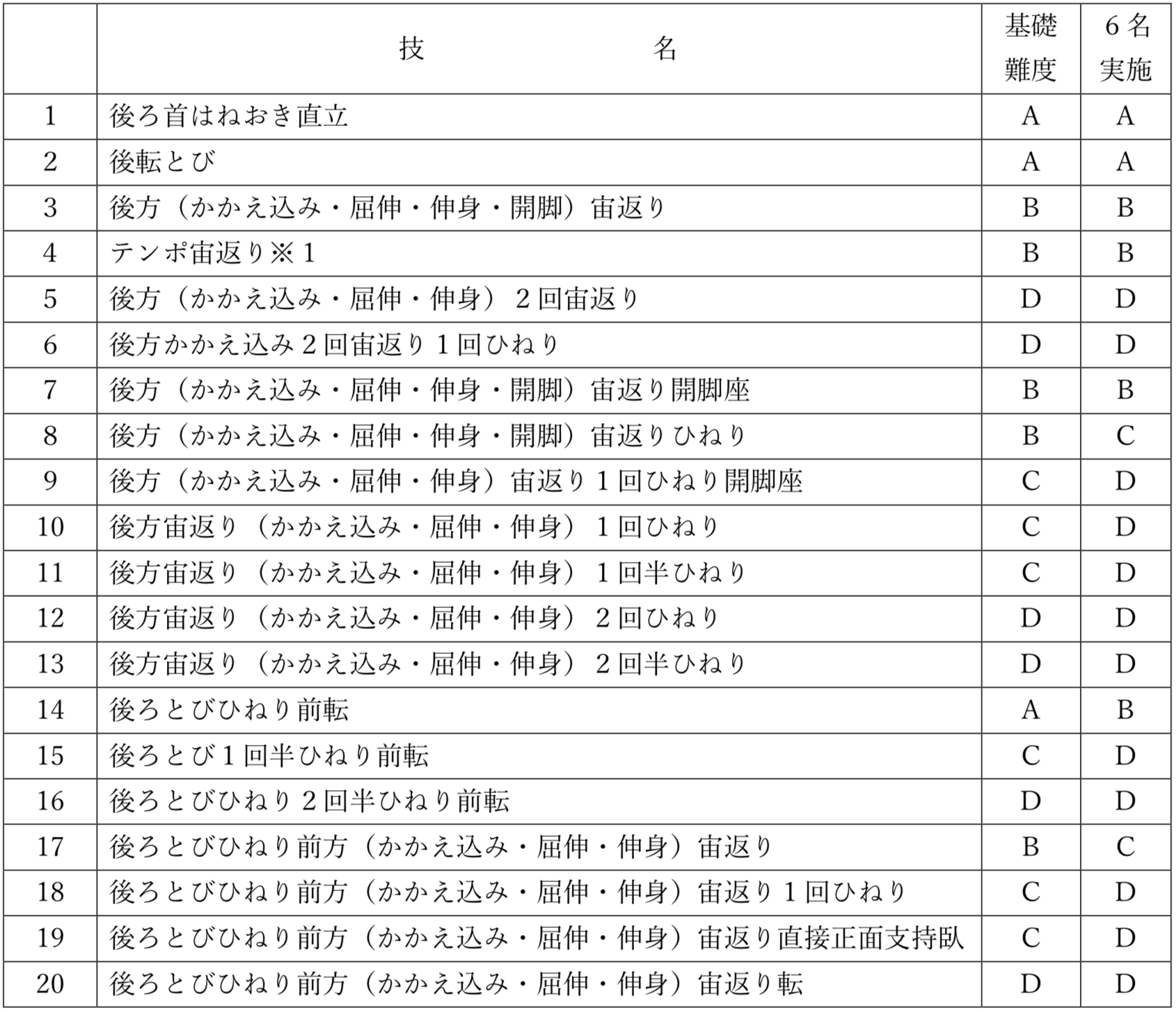
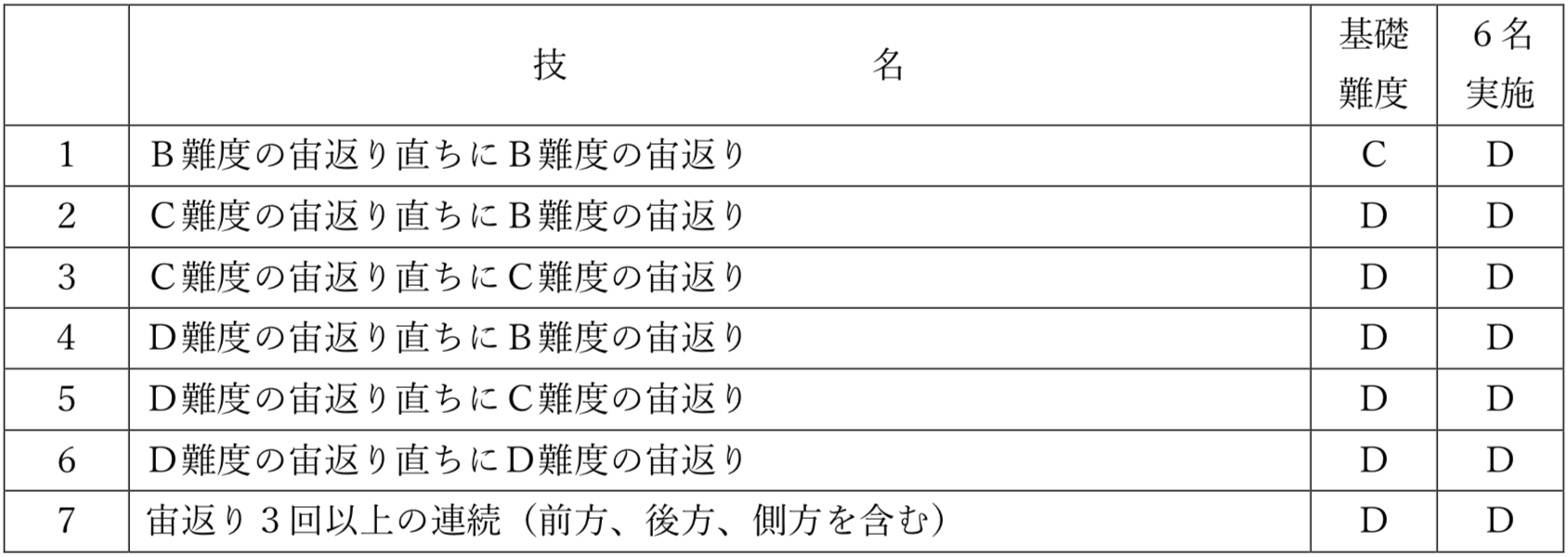
The value of tumbling difficulties is determined from the following basic difficulties. Tables of twisting elements, forward tumbling elements, backward tumbling elements, salto combinations and tumbling combinations are shown below. ** For elements other than saltos, tumbling in 2-3 and 3-15 is treated in the same way. * A tempo salto is treated as such only when followed immediately by backward tumbling. * Upgrades apply only when all six gymnasts perform the element at the same time. Three or more consecutive back handsprings in which some are replaced by tumbling of B difficulty or higher are treated in the same way. A layout back salto with an added twist is also treated in the same way.
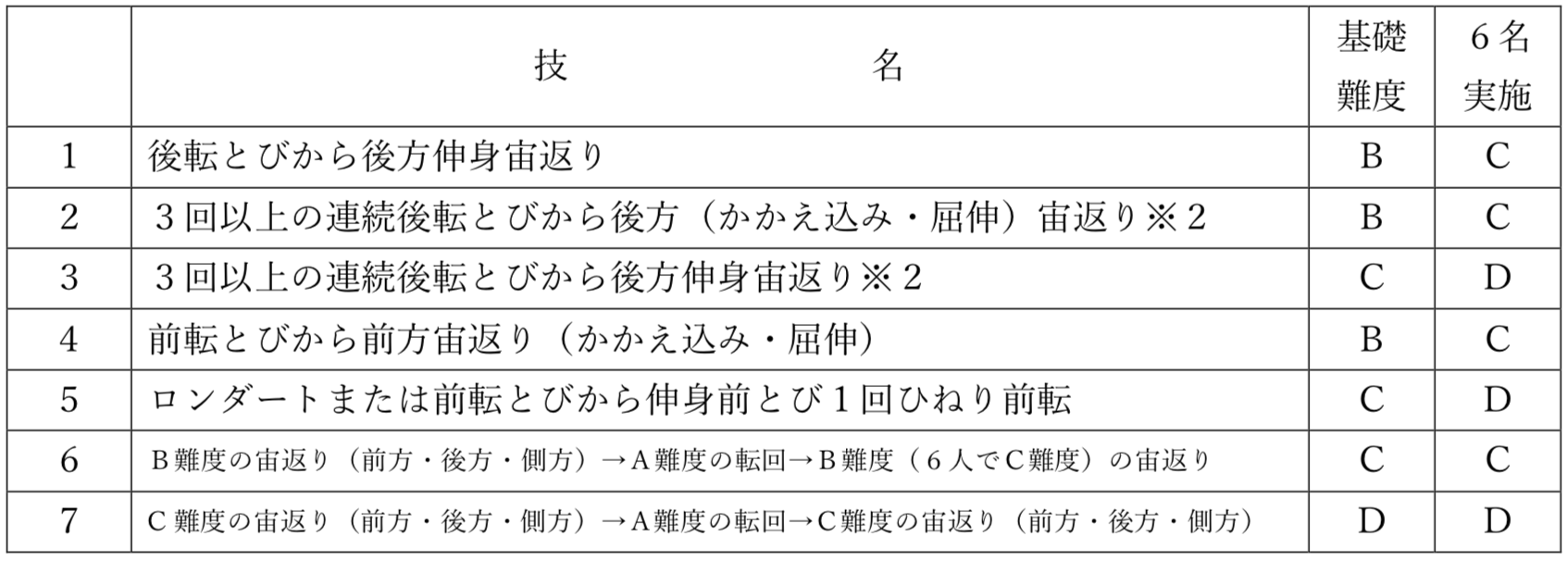
3 Difficulty Combinations in the Group Competition
Article 68 Difficulty of Crossing Elements and Partner Elements
[Crossing elements] The difficulty of crossing elements is as follows. 1. When a gymnast tumbles over gymnasts performing free-hand elements, the difficulty of the tumbling element applies. 2. A tumbling crossing element must pass over the other gymnast during their tumbling. As a minimum, it must pass over just before the other gymnast lands. 3. A tumbling crossing element must pass over the other gymnast during their tumbling. 4. If it passes over after the landing, it is treated as in (1). 5. Difficulty of two-level crossing elements (see the table below) 6. A crossing element of three or more levels performed entirely with tumbling of B difficulty or higher is a D difficulty. If an A difficulty is included, this does not apply. [Partner and pyramid elements] The difficulty of partner and pyramid elements is as follows. 1. Table of partner and pyramid element difficulties (see the table below) * They count as difficulties when followed by tumbling. * When the tumbling is C difficulty or higher, the difficulty of that tumbling applies. 2. Upgrades in partner and pyramid elements a. When a gymnast jumps over a handstand on a partner's shoulders, jumping elements rise one rank and saltos rise two ranks. b. In a partner handstand, a one-arm handstand or support with straight arms by the supporting gymnast raises the difficulty one rank. [Judging the difficulty of a series] When gymnasts divide into groups and perform tumbling one after another, the difficulty is judged as follows. 1. As a rule, except for crossing elements and partner and pyramid elements, the difficulty performed by three or more gymnasts applies. A higher difficulty may be counted as a lower one. 2. When groups perform tumbling of the same difficulty a. Divided 3 and 3 i. As a rule, the difficulty of the group that performed the higher difficulty applies. ii. Even with different elements, combinations whose difficulty rises when performed by six or more gymnasts are upgraded. * Elements whose difficulty is upgraded when performed by six gymnasts are shown below. b. Divided 4 and 2, or 5 and 1 i. As a rule, the difficulty of the group that performed the higher difficulty applies. ii. Even with different elements, combinations whose difficulty rises when performed by six or more gymnasts are upgraded. iii. If the smaller group performs a crossing element or a partner or pyramid element, it is counted as a difficulty, and the group with the higher difficulty applies. 3. When groups perform tumbling of the same difficulty 1. The difficulty performed by three or more gymnasts applies. 2. If a crossing element or a partner or pyramid element in the series is the highest difficulty in the series, that difficulty applies regardless of the number of gymnasts. 3. If every difficulty is performed by fewer than three gymnasts, even after counting higher difficulties as lower ones, no difficulty is recognized.
4 Difficulty in the Individual Competition
Article 69 Apparatus Handling and Difficulty in Tumbling
The difficulty of tumbling performed in a routine is determined by the table of basic difficulties. However, it rises one rank in the following cases. 1. Tumbling performed while the apparatus is in the air rises one rank from the difficulty of that tumbling. 2. Tumbling performed with two or more apparatus handlings. a. Stick i. Rotating the stick two or more times, holding it at the end or in the middle. ii. Rotating the stick one or more times while passing it between the hands. b. Ring i. Spinning one ring or both rings two or more times. ii. Spinning the two rings one rotation each, one after the other. iii. Spinning one ring one or more times while passing it between the hands. c. Rope i. Turning the rope two or more times with one or both hands, open, folded in two, three or four, and so on. ii. Turning the rope one or more times while passing it between the hands. d. Club i. Rotating the club two or more times, holding it by the head or the neck. ii. Rotating the two clubs one rotation each, one after the other. iii. Rotating one club one or more times while passing it between the hands. e. Other apparatus handling i. Bouncing the apparatus on the floor and catching it during tumbling. ii. Rolling the apparatus during tumbling and catching it on landing.
Article 70 Throw-and-Catch Difficulty
When a throw and catch is performed in a routine, the difficulty is determined as follows by the number of free-hand elements (*) or tumbling elements performed during the throw. If tumbling is included, the difficulty is compared with the condition in Article 69 (1), and the higher one applies. * Here, a free-hand element counts as one only when it is a 360° rotation around the vertical or horizontal axis.
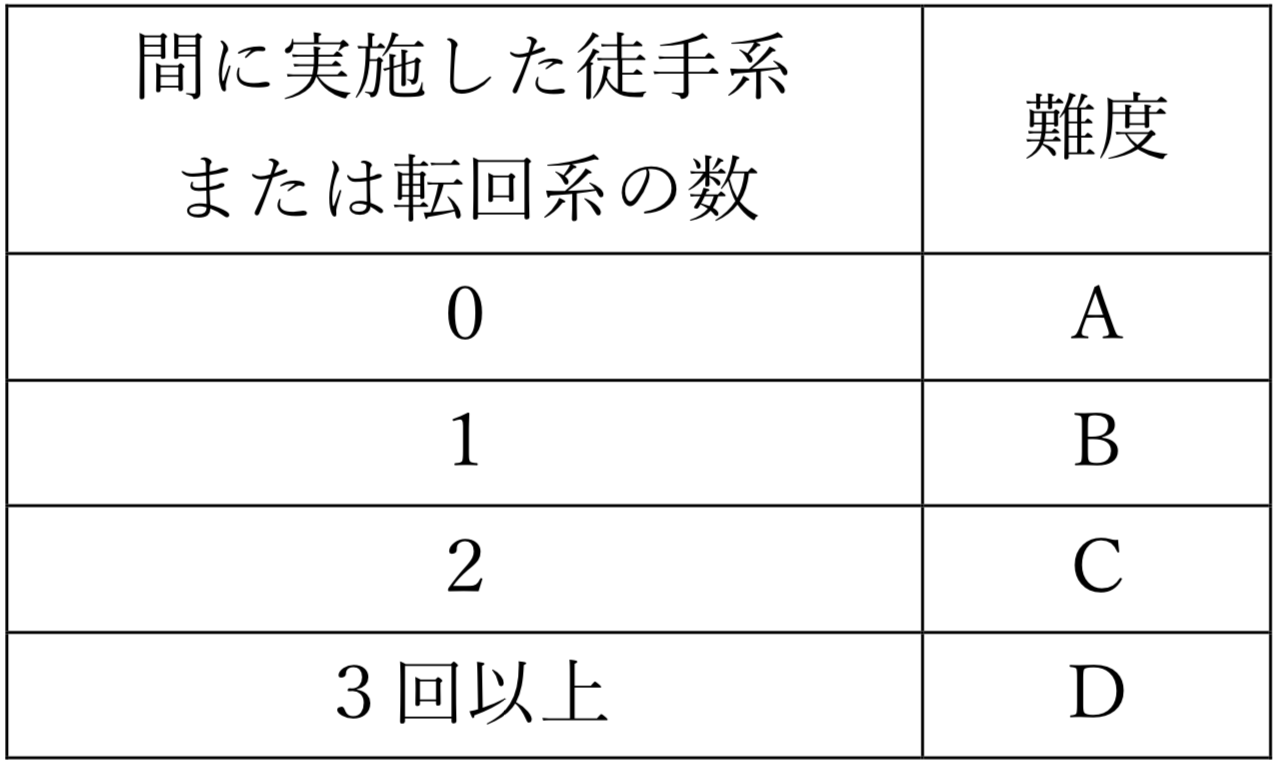
Article 71 Difficulty of Free-Hand Elements with Apparatus Handling
When a free-hand difficulty is performed with apparatus handling in a routine, the free-hand difficulty applies.
Chapter 3 Appendix
1 Illustrated Difficulties
1 Free-Hand Difficulties
Article 1 Free-Hand Difficulties
Article 2 Tumbling Difficulties
2 Special Rules
Article 3 Rules for Juniors
Except as shown below, the Rhythmic Gymnastics Code of Points of the Japan Gymnastics Association applies. [Prohibited elements] The following elements are prohibited in both the group and the individual competition. If a prohibited element is performed, both composition and execution are scored 0 points. 1. Forward salto with 1½ rotations or more 2. Double back salto or more 3. Forward salto landing directly in front lying support 4. Double back salto landing directly in front lying support * All of these include performance from partner elements. (1) and (3) also include twists from a back handspring. [Difficulty requirements] 1 D, 2 C and 3 B for both the group and the individual competition. [Special difficulties] In the group competition, the following tumbling elements are counted as special difficulties. [Relaxed deductions] Missing triple under with the rope [Apparatus specifications] Because of large differences in body size, if apparatus sold by suppliers designated by the Japan Gymnastics Association cannot be used, self-made apparatus are allowed as long as they meet the specifications.
.png)
Article 4 Rules for Elementary School Students
Except as shown below, the Rhythmic Gymnastics Code of Points of the Japan Gymnastics Association applies. [Group competition] Free routine 1. The free routine is based on Radio Taiso No. 1 and composed of free-hand exercises. 2. The duration of the routine is that of Radio Taiso No. 1. 3. The group routine is performed by four or more gymnasts. 4. Points for the free routine The following five criteria are used. Each is scored out of 10 points, and the average is each judge's score. Each team's score is the average of all judges' scores. Scoring criteria a. Were the exercises performed accurately, with amplitude, depth and accents? b. Was there harmony between the music and the exercises? c. Were changes of formation and movement across the floor well designed? d. Was the whole routine performed rhythmically? e. Did the whole team perform energetically and joyfully? 5. Accompanying music is recommended, but the routine may also be performed to spoken counts. 6. Tumbling may be included, excluding saltos. 7. Changes and movements of formations should be well designed. 8. Attire is free. 9. As a standard, the judging panel has 10 judges. 10. Awards follow the competition guidelines. [Score sheet] Routines are scored from the following viewpoints.
.png)
Article 5 Rules of the All Japan High School Athletic Federation
Except as shown below, the Men's Rhythmic Gymnastics Code of Points of the Japan Gymnastics Association applies. [Prohibited elements] The following elements are prohibited in both the group and the individual competition. If a prohibited element is performed, the routine is scored 0 points. * All of these include partner elements. 1. Forward salto with 1½ rotations or more (including twists from a back handspring) 2. Double back salto or more [Restricted elements] An element going from a backward tumbling element with a twist directly into front lying support may be used only once within the composition requirements of Article 31, Chapter 2 of the men's Code of Points. If it is used more often, the composition score of the routine is 0 points. [Emblem] The emblem must follow the rules and be distinguishable from the uniform. [Breaking ties] 1. Group competition a. The team with the higher composition score. b. If still tied, the team with the higher total of the chief judges' scores (composition and execution). c. If still tied, the team with the higher total of the eight judges' scores, excluding the chief judges. d. If still tied, the decision is left to the organizer. 2. Individual competition a. The gymnast with the highest score on either of the two apparatus. b. If still tied, the gymnast with the higher total of the chief judges' scores on the two apparatus. c. If still tied, the gymnast with the higher total of the eight judges' scores, excluding the chief judges. d. If still tied, the decision is left to the organizer. [Power failures and injuries during a routine] 1. If the power fails in the competition hall because of lightning or similar and the accompanying music stops, the routine may be stopped at the Jury President's discretion and performed again. 2. If a gymnast is injured during a routine, the routine may be stopped at the team manager's discretion. [Rankings and awards] If a gymnast has to withdraw from an apparatus because of an unforeseen accident or similar, the gymnast remains eligible for the apparatus championship awards.
3 Free-Hand Routines
Article 6 Basic Free-Hand Element Groups
1. Various free-hand movements Arm and leg movements, forward bends, side bends, trunk rotations, arm swings, knee bends, chest arches, body springs, body waves and other combined movements 2. Various jumps Stag jumps, split leaps, straddle jumps and other jumps. 3. Flexibility Straddle forward bends, splits, pike forward bends and other flexibility elements. 4. Balances Various balances. 5. Handstands Various handstands. 6. Various steps and runs Various steps. 7. Turns and pivots Turns and pivots. These elements can be performed with a wide range of movements: in various directions and planes, with or without traveling, on one foot or both feet, combined with arm movements, and so on.
Article 7 Requirements for the Composition
The composition of a routine must include all kinds of free-hand elements, make full use of jumping power, flexibility and dexterity, show all kinds of changes in movement, use original technique, and flow with quick movements without static pauses (of 3 seconds or more). Forward rolls, backward rolls, cartwheels and bridges may be used as links between movements.
Article 8 Execution
Execution must bring out the characteristics of rhythmic gymnastics accurately: correct body position, amplitude, control of the points of support, accuracy of movement across the floor, and so on. All body movements must be continuous, with changes between fast and slow and a close connection of dynamics, amplitude and speed. All elements must be performed with the whole body, including the head and arms; that is, movements must not be isolated to one part of the body.
Article 9 Typical Faults in Free-Hand Elements
[Composition faults] The table of faults is shown below. [Execution faults] General guidelines for judging the level of free-hand difficulties 1. Basic free-hand elements are usually counted as A difficulties. 2. Free-hand elements are regarded as B difficulties in the following cases. a. When a high level of physical ability is needed to perform them. (e.g. a back bend below the horizontal, or complex movements in the air during a jump) b. When a high level of coordination is needed to perform them. (e.g. supporting the body on a small area (the toes), holding a balance longer, or a pivot of 1½ turns (540°) or more) c. When two different elements are performed at the same time. (e.g. a full body wave while holding a balance) d. When two or more elements (of the same or different kinds) are performed in a row without other movements in between. (e.g. consecutive jumps without steps in between)
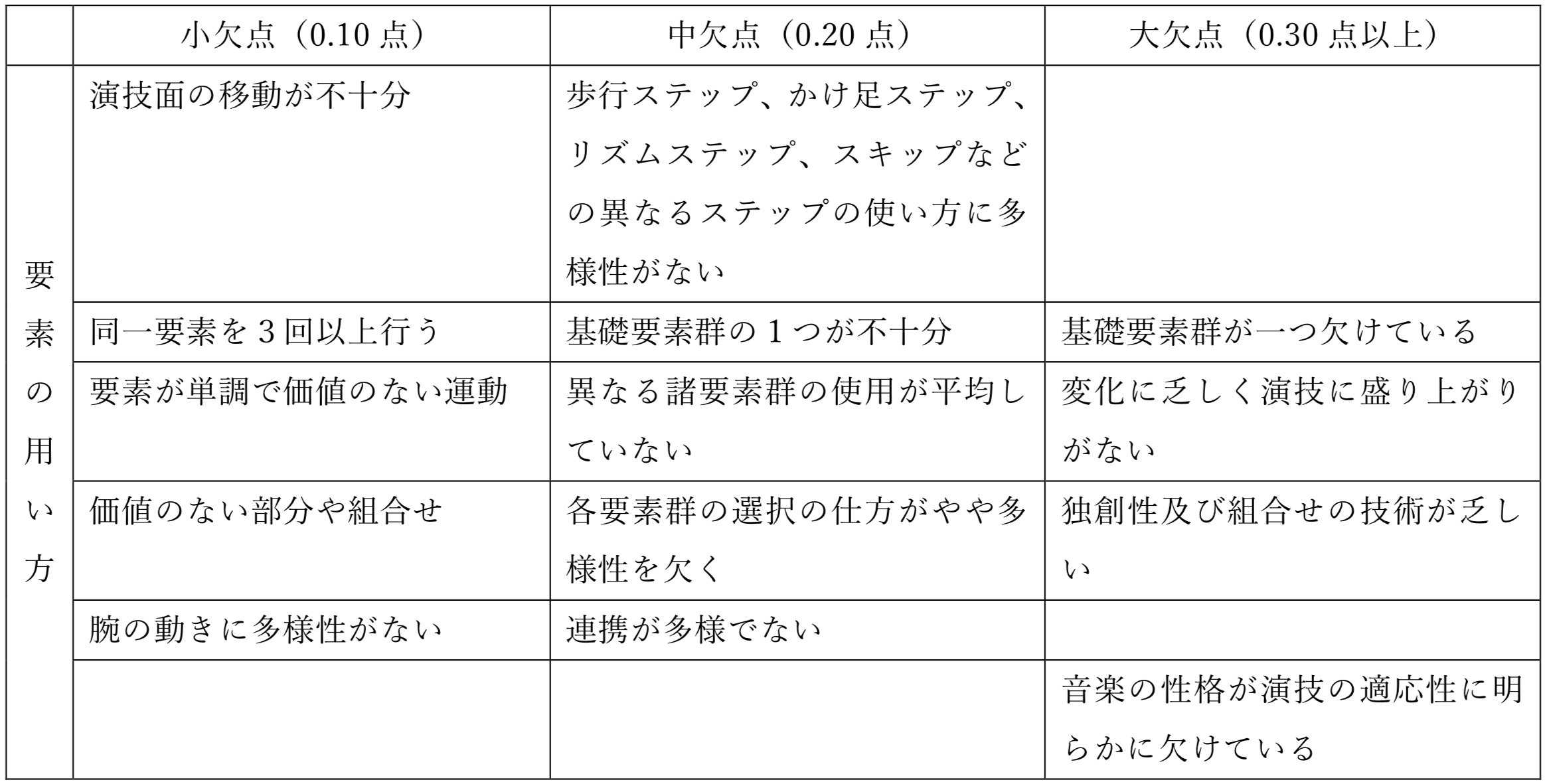
Article 10 Tables of Free-Hand Difficulties
In the tables below, the elements are listed by group. These elements can be performed and arranged in a great many ways. To determine the level of difficulty, see the section on general guidelines. * In the group competition, free-hand difficulties rise one rank when all gymnasts perform them.
.png)
.png)
.png)
.png)
.png)
.png)
.png)
.png)
4 Individual Routines
1 Stick Routines
Article 11 Stick Specifications
1. Material Wood or synthetic material 2. Weight At least 200 g 3. Shape Length 90 cm to 110 cm, thickness (diameter) 2.5 cm to 3.5 cm. Rubber or synthetic caps with a maximum diameter of 4 cm and a length of up to 5 cm may be attached to the ends. The stick may be wholly or partly wrapped with tape. 4. Color Free
Article 12 Stick Technique
[Element groups] 1. Basic element groups a. Propeller rotations (mills) b. Rolls c. Throws d. Tumbling with the stick 2. Other element groups a. Swings b. Circles c. Slides These elements can be performed taking the following into account. a. With or without passing the stick between the hands. b. In various directions and in various planes. c. With or without traveling. d. On one foot or both feet, with one hand or both hands. 3. Handling the stick The stick must not stop moving, even when changing planes, and must keep moving using the momentum that comes from its own weight. For propeller rotations and swings, the stick must be handled like an extension of the arm. Stick handling must be accompanied by body movement. 4. Holding the stick During wide movements (e.g. swings and propeller rotations), the stick is usually held lightly with the fingers at the end or in the middle. The stick may also rest briefly on the open hand.
Article 13 Requirements for the Composition
1. Propeller rotations At least two propeller rotations must be included. 2. Rolls At least one roll of at least 1 m must be included. 3. Throws a. Minimum requirements for throws i. At least three throws must be included. ii. At least one throw with the left hand caught with the left hand, and at least one throw with the right hand caught with the right hand, must be included. b. Height of throws i. A throw must rise at least 2 m from the point of release. 4. Tumbling elements a. Forward, backward and sideways tumbling must be included. b. The stick must be used actively during tumbling. 5. Elements a. Propeller rotations in various directions and planes, combined with free-hand elements. b. Various kinds of throws (horizontal throws, vertical throws, horizontal and vertical propeller throws, one-hand and two-hand throws). c. Various circles (small, medium and large, using the wrist, forearm and arm respectively). d. Rhythmic rotations of the stick. e. A variety of grips. f. Various rolls. * When the stick is thrown, the body must always be moving. Throughout the routine, it is essential that the stick always moves in harmony with the body.
Article 14 General Guidelines for Judging the Level of Difficulty
Elements characteristic of the stick usually count as B difficulties when combined with B difficulty free-hand elements, and as C difficulties when combined with C difficulty free-hand elements. 1. A difficulty The following elements count as A difficulties when combined with free-hand or tumbling elements. a. An A difficulty tumbling movement performed while holding the stick. b. One handling of the stick during an A difficulty tumbling movement. c. Catching the stick after a throw without performing anything during the throw. d. Other combinations with the technical value of an A difficulty. 2. B difficulty The following stick elements count as B difficulties when combined with B difficulty free-hand elements. a. When controlling the stick is difficult i. Throwing and catching the stick. (e.g. throwing the stick at least 2 m and catching it, combined with a free-hand difficulty element.) b. When coordinating movements is difficult i. Combining free-hand elements with the stick. (e.g. a propeller rotation combined with a B difficulty free-hand element.) c. When catching the stick is difficult i. Rotating while the stick is in the air before catching it. (e.g. throwing the stick in various ways and catching it after various rotations during the throw, such as a forward roll.) ii. Throwing and catching the stick outside the field of vision. (e.g. throwing the stick in various ways and catching it outside the field of vision.) 3. C difficulty The following elements count as C difficulties when combined with tumbling elements. a. A B difficulty tumbling movement performed while the stick is in the air. b. Two or more handlings of the apparatus during a B difficulty tumbling movement. c. A C difficulty tumbling movement. d. Two free-hand or tumbling elements combined while the stick is in the air. e. Other combinations with the high technical value of a C difficulty. 4. D difficulty The following elements count as D difficulties when combined with tumbling elements. a. A C difficulty tumbling movement performed while the stick is in the air. b. Two or more handlings of the stick during a C difficulty tumbling movement. c. A D difficulty tumbling movement. d. Three or more free-hand or tumbling elements combined while the stick is in the air. e. Other combinations with the high technical value of a D difficulty.
2 Ring Routines
Article 15 Ring Specifications
1. Material Wood or synthetic material. 2. Weight At least 200 g each. 3. Shape Inner diameter 40 cm to 45 cm, thickness (diameter) 2.5 cm to 3.5 cm. The rings may be wholly or partly wrapped with tape. 4. Color Free. The two rings may be different colors.
Article 16 Ring Technique
[Element groups] 1. Basic element groups a. Spins (on the hand or body) b. Rolls c. Throws d. Tumbling with the rings 2. Other element groups a. Swings b. Circles c. Asymmetric movements These elements can be performed taking the following into account. a. Handling both rings at the same time. b. Handling them one after the other. c. In various directions. d. With or without traveling. e. On one foot or both feet, with one hand or both hands. 3. Handling the rings The rings must not stop moving, even when changing planes, and must keep moving using the momentum that comes from their own weight. For spins and swings, the rings must be handled like an extension of the arm. Ring handling must be accompanied by body movement. 4. Holding the rings To perform the elements characteristic of the rings, the rings must be held lightly so that they move freely. They may also be gripped firmly for a moment.
Article 17 Requirements for the Composition
1. Spins (on the hand or body) Two spins of at least two rotations must be included. 2. Rolls At least one roll of at least 1 m must be included. 3. Throws a. Requirements for throws i. At least three throws must be included. ii. At least one simultaneous throw of both rings must be included. A throw with the rings joined (linked together) is not regarded as a simultaneous throw. iii. A simultaneous throw must be made with one hand, both hands or the feet. The catch is free. b. Height of throws i. A throw must rise at least 2 m from the point of release. 4. Tumbling elements a. Forward, backward and sideways tumbling must be included. b. The rings must be used actively during tumbling. 5. Elements a. Various kinds of spins. b. Various kinds of throws. c. Swings, circles and similar movements with changes of plane. d. Asymmetric movements. e. A variety of grips. f. Various kinds of rolls. * When only one ring is thrown, the other ring must also be moving. Throughout the routine, it is essential that both rings always move in harmony with the body.
Article 18 General Guidelines for Judging the Level of Difficulty
Elements characteristic of the rings usually count as B difficulties when combined with B difficulty free-hand elements, and as C difficulties when combined with C difficulty free-hand elements. 1. A difficulty The following elements count as A difficulties when combined with free-hand or tumbling elements. a. An A difficulty tumbling movement performed while holding the rings. b. One handling of the rings during an A difficulty tumbling movement. c. Catching the ring after a throw without performing anything during the throw. d. Other combinations with the technical value of an A difficulty. 2. B difficulty The following elements count as B difficulties when combined with B difficulty free-hand elements. a. When the rhythmic relationship between the rings and the body movement is especially complex i. Elements that require complete synchronization between the movement of the rings and the movement of the body. b. When keeping the plane of the ring is difficult because of the surface it moves on i. A long roll over an uneven surface. e.g. rolling the ring along both arms stretched sideways, combined with a B difficulty free-hand element. ii. When the momentum must be adjusted to control the amplitude and number of twisting spins of the ring. (e.g. throwing the ring while twisting it two or more times, combined with a B difficulty free-hand element.) c. When controlling the ring is difficult i. Throwing and catching the ring. (e.g. throwing the ring with two or more rotations and catching it, combined with a B difficulty free-hand element.) d. When coordinating movements is difficult i. Combining free-hand elements with the rings. (e.g. spinning both rings at the same time, combined with a B difficulty free-hand element.) e. When catching the ring is difficult i. Rotating while the ring is in the air before catching it. (e.g. throwing the ring in various ways and catching it after various rotations during the throw, such as a forward roll.) ii. Throwing or catching the ring outside the field of vision. (e.g. throwing the ring in various ways and catching it outside the field of vision.) 3. C difficulty The following elements count as C difficulties when combined with tumbling elements. a. A B difficulty tumbling movement performed while the ring is in the air. b. Two handlings of the rings during a B difficulty tumbling movement. c. A C difficulty tumbling movement. d. A B difficulty tumbling movement performed while the ring is in the air. e. Other combinations with the high technical value of a C difficulty. 4. D difficulty The following elements count as D difficulties when combined with tumbling elements. a. A C difficulty tumbling movement performed while the ring is in the air. b. Two or more handlings of the rings during a C difficulty tumbling movement. c. A D difficulty tumbling movement. d. Three or more free-hand or tumbling elements combined while the ring is in the air. e. Other combinations with the high technical value of a D difficulty.
3 Rope Routines
Article 19 Rope Specifications
1. Material Hemp or synthetic fiber. A synthetic rope must be as light and supple as a hemp rope. 2. Weight No requirement. 3. Shape Length is free. The rope must not have handles, but one or two knots may be tied at each end. If the material is the same throughout, the rope may be the same thickness throughout or thicker in the middle than at the ends. Frayed ends of up to 3 cm beyond the knots are allowed. 4. Color Free.
Article 20 Rope Technique
[Element groups] 1. Basic element groups a. Various kinds of consecutive jumps b. Throws c. Tumbling with the rope 2. Other element groups a. Swings b. Circles These element groups can be performed taking the following into account. a. With the rope open or folded. b. Held in one hand or both hands. c. In various directions and in various planes. d. With or without traveling. e. With or without traveling. f. On one foot or both feet, turning the rope in various directions. 3. Handling the rope The rope must always keep a clear shape. Its movement must be continuous: the rope is always moving, with enough momentum that it never looks slack or lifeless. The amplitude of the movement is related to the rhythm (fast rhythm = restricted movements, slow rhythm = broad movements). 4. Holding the rope To perform the elements characteristic of the rope, it must be held lightly so that it moves freely. The rope may also be wrapped around the body for a moment or held taut between the arms.
Article 21 Requirements for the Composition
1. Jumps The jumps a to d below must be included. Rope jumps within tumbling do not count. a. At least two consecutive forward jumps on the spot (e.g. two or more forward single or double unders.) b. At least two consecutive backward jumps on the spot (e.g. two or more backward single or double unders.) c. At least two consecutive jumps traveling at least 6 m (e.g. two or more jumps while traveling.) d. A triple under (e.g. one or more forward triple unders.) * Among a to d, when d is performed together with another element, each counts as its own element. (e.g. traveling at least 6 m while performing forward triple unders.) 2. Throws a. Requirements for throws At least three throws must be included. b. Height of throws A throw must rise at least 2 m from the point of release. 3. Tumbling elements a. Forward, backward and sideways tumbling must be included. b. The rope must be used actively during tumbling. 4. Elements a. Various kinds of consecutive jumps, forward or backward b. Various kinds of movements in various directions and planes (swings, circles, figure eights) c. Various kinds of throws d. Changes in the speed of the rope e. Changes in how the rope is held (open, folded, in one hand, in both hands, by the end, by the middle, and so on) * Handling the rope folded is characteristic of this apparatus, but the routine must not rely too much on it. Routines with the rope open are important. When elements are performed with the rope in one hand, the left and right hands must be used equally.
Article 22 General Guidelines for Judging the Level of Difficulty
Elements characteristic of the rope usually count as B difficulties when combined with B difficulty free-hand elements, and as C difficulties when combined with C difficulty free-hand elements. 1. A difficulty The following elements count as A difficulties when combined with free-hand or tumbling elements. a. An A difficulty tumbling movement performed while holding the rope. b. One handling of the rope during an A difficulty tumbling movement. c. Catching the rope after a throw without performing anything during the throw. d. Other combinations with the technical value of an A difficulty. 2. B difficulty The following elements count as B difficulties when combined with B difficulty free-hand elements. a. When the rhythmic relationship between the rope and the body movement is complex. i. Two (or more) rope movements during one B difficulty free-hand element. (e.g. turning the rope twice during one B difficulty jump, drawing horizontal circles alternately above the head and under the feet.) ii. Elements that require complete synchronization between the movement of the rope and the movement of the body. (e.g. jumping over the rope at the moment of catching it after a throw.) b. When a change of movement makes handling the rope difficult. i. Moving from large rope movements to slow ones. (e.g. throwing the rope during a jump, catching it without disturbing its path and immediately continuing with slow rope movements.) c. When the length of the rope makes handling difficult. i. Throwing one end of the rope first, then the other end, making it turn once before catching it. Wrapping the open rope around the body several times without interruption, from the ankles upward or the other way. d. When catching the rope is difficult. i. Rotating while the rope is in the air before catching it. (e.g. throwing the rope in various ways and catching it after various rotations during the throw, such as a forward roll.) ii. Throwing and catching the rope outside the field of vision. (e.g. throwing the rope in various ways and catching it outside the field of vision.) 3. C difficulty The following elements count as C difficulties when combined with tumbling elements. a. A B difficulty tumbling movement performed while the rope is in the air. b. Two handlings of the rope during a B difficulty tumbling movement. c. A C difficulty tumbling movement. d. Two free-hand or tumbling elements combined while the rope is in the air. e. Other combinations with the high technical value of a C difficulty. 4. D difficulty The following elements count as D difficulties when combined with tumbling elements. a. A C difficulty tumbling movement performed while the rope is in the air. b. Two or more handlings of the rope during a C difficulty tumbling movement. c. A D difficulty tumbling movement. d. Three or more free-hand or tumbling elements combined while the rope is in the air. e. Other combinations with the high technical value of a D difficulty.
4 Club Routines
Article 23
1. Material Wood or synthetic material. 2. Weight At least 200 g each. 3. Shape Similar in shape to a bottle, with three parts: head, neck and body. Length 40 cm to 50 cm. The head (ball) at the end has a maximum diameter of 4 cm, the neck a diameter of 1.5 cm to 3.5 cm, and the body a diameter of 6 cm to 9 cm and a length of 12 cm to 18 cm. The clubs may be wholly or partly wrapped with tape. 4. Color Free. The two clubs may be different colors.
Article 24 Club Technique
[Element groups] 1. Basic element groups a. Propeller rotations (mills) b. Rolls c. Throws d. Tumbling with the clubs 2. Other element groups a. Swings b. Circles c. Asymmetric movements d. Small circles These elements can be performed taking the following into account. a. Handling both clubs at the same time, or one after the other. b. In various directions. c. With or without traveling, on one foot or both feet. [Handling the clubs] The clubs must not stop moving, even when changing planes, and must move using the momentum that comes from their own weight. During small circles, propeller rotations and swings, the clubs are moved by the wrists. During other movements, the clubs must be handled like an extension of the arm. The routine must not be performed holding the clubs by the neck for a long time. [Holding the clubs] During wide movements (e.g. swings and propeller rotations), the club is usually held lightly with the fingers at the head. During propeller rotations, small circles and similar movements, the club must be held lightly with the fingers so that the head turns freely in the hollow of the hand. The club may also be held briefly by the neck or the body, or rest on the open hand.
Article 25 Requirements for the Composition
1. Propeller rotations (mills) At least two propeller rotations of at least two turns must be included. 2. Rolls At least one roll of at least 50 cm must be included. 3. Throws a. Requirements for throws i. At least three throws must be included. ii. At least one simultaneous throw must be included. iii. A simultaneous throw of both clubs must be made with one hand, both hands or the feet. The catch is free. b. Height of throws i. A throw must rise at least 2 m from the point of release. 4. Tumbling elements a. Forward, backward and sideways tumbling must be included. b. The clubs must be used actively during tumbling. 5. Elements a. Propeller rotations in various directions and planes, combined with free-hand elements. b. Various kinds of throws (one club, both clubs at the same time, both clubs one after the other). c. Various circles (small, medium and large, using the wrist, forearm and arm respectively). d. Asymmetric movements. e. A variety of grips. f. Various rolls. * When only one club is thrown, the other club must also be moving. Throughout the routine, it is essential that both clubs always move in harmony with the body.
Article 26 General Guidelines for Judging the Level of Difficulty
Elements characteristic of the clubs usually count as B difficulties when combined with B difficulty free-hand elements, and as C difficulties when combined with C difficulty free-hand elements. 1. A difficulty The following elements count as A difficulties when combined with free-hand or tumbling elements. a. An A difficulty tumbling movement performed while holding the clubs. b. One handling of the clubs during an A difficulty tumbling movement, excluding club rolls. c. Catching the club after a throw without performing anything during the throw. d. Other combinations with the technical value of an A difficulty. 2. B difficulty The following club elements count as B difficulties when combined with B difficulty free-hand elements. a. When controlling the clubs is difficult. i. Throwing both clubs at the same time. (e.g. throwing both clubs at the same time and catching them, combined with a B difficulty free-hand element, or throwing both clubs at least 2 m and catching them.) b. When coordinating movements is difficult. i. Performing different elements at the same time. (e.g. performing a different element with each club at the same time.) ii. Performing the same element with a delay. (e.g. propeller rotations combined with a B difficulty free-hand element.) c. When throwing and catching the clubs is difficult. i. Throwing and catching the clubs outside the field of vision. (e.g. throwing the clubs in various ways and catching them outside the field of vision.) ii. Rotating while the clubs are in the air before catching them. (e.g. throwing the clubs in various ways and catching them after various rotations during the throw, such as a forward roll.) 3. C difficulty The following elements count as C difficulties when combined with tumbling elements. a. A B difficulty tumbling movement performed while the club is in the air. b. Two handlings of the clubs during a B difficulty tumbling movement. c. A C difficulty tumbling movement. d. Two free-hand or tumbling elements combined while the club is in the air. e. Other combinations with the high technical value of a C difficulty. 4. D difficulty The following elements count as D difficulties when combined with tumbling elements. a. A C difficulty tumbling movement performed while the club is in the air. b. Two or more handlings of the clubs during a C difficulty tumbling movement. c. A D difficulty tumbling movement. d. Three or more free-hand or tumbling elements combined while the club is in the air. e. Other combinations with the high technical value of a D difficulty.
5 Regulations for Certified Judges
Article 27 Purpose
These regulations set out matters concerning certified judges.
Article 28 Duties and Categories of Certified Judges
Certified judges are divided into the following four categories for each of the four disciplines: men's and women's artistic gymnastics and men's and women's rhythmic gymnastics. 1. Category 3 certified judges (hereinafter "Category 3") may judge district and prefectural championships and similar competitions. 2. Category 2 certified judges (hereinafter "Category 2") may judge regional competitions covering several prefectures, the West Japan and East Japan Championships, and similar competitions. 3. In special circumstances, with the consent of the person in charge of the competition, they may also judge national-level competitions. 4. Category 1 certified judges (hereinafter "Category 1") may judge national-level competitions, the All Japan Student Championships, the National High School Championships, the National Sports Festival and all other national competitions. 5. Honorary judges (hereinafter "Honorary") do not judge competitions. 6. Line judges and timekeepers must hold one of the qualifications in (1) to (3).
Article 29 Authority for Certification
Certified judges are certified as follows. 1. The review for certification and renewal is carried out by the Men's Rhythmic Gymnastics Committee, and the President certifies the judges. The review for Category 3 and Category 2 is carried out by the member organizations. Applications for certification and renewal are made through the prefectural gymnastics associations. 2. To carry out this work, the Men's Rhythmic Gymnastics Committee appoints a small number of expert members.
Article 30 Eligibility and Honorary Status
Eligibility for the examination and for honorary status is as follows. 1. Category 3: people with competitive experience who are at least 16 years old in the year concerned. 2. Category 2: people at least 18 years old, at least one year after obtaining Category 3, who have judged at least once at an official competition. 3. Category 1: people at least 20 years old in the year concerned who meet one of the following, or who hold an equivalent qualification recognized and recommended by a member organization. a. People who hold Category 2 and have judged at least twice at official competitions at prefectural level or higher. b. People who represented Japan at an international competition and are recommended for the competition. 4. Honorary: people who have held Category 2 and Category 1 for a total of at least 20 years, are at least 45 years old in the year concerned, and are recognized by a member organization, which applies to the Association. 5. To obtain an international judge qualification, a person must hold Category 1 certified by the Association and be recommended by the Association.
Article 31 Certification Courses
Certification courses are held as follows. 1. As a rule, the Category 1 course is held by the Association once every two years, and the Category 3 and Category 2 courses are held by the member organizations. 2. As a rule, a certification course lasts at least two days, with the following content. a. Category 3: the instructors are Category 1 judges of the host member organization or a neighboring member organization, who give lectures and a scoring test. b. Category 2: the instructors are two or more Category 1 judges of the host member organization or a neighboring member organization, who give lectures and a scoring test. c. Category 1: the instructors are two or more people in charge from the Association, who give lectures, a scoring test and a theory test.
Article 32 Training Sessions
As a rule, training sessions are held once every four years, in line with the FIG revision cycle. If the competition rules or the Code of Points change in the years in between, the changes are communicated as follows. 1. Changes are communicated to Category 1 judges and member organizations on the Association's website. Depending on the extent of the changes, a training session to communicate them is held promptly if necessary. 2. Communication or training for Category 2 and Category 3 judges is carried out by the member organizations. 3. A training session may be held together with a certification course.
Article 33 Period of Validity
The period of validity of the qualification is as follows. 1. A certified judge's certificate is valid for one year, from April 1 to March 31 of the following year. If the application for certification is made between July 1 and March 31 of the following year, the certification takes effect on April 1 of the following year and is valid for that period. 2. A qualification renewed by the application in Articles 8 and 10 is also valid for one year, as in the previous item. 3. Honorary status does not expire.
Article 34 Renewal of the Qualification
Renewal of the qualification is as follows. 1. Those who wish to renew must apply for renewal by the prescribed procedure. Honorary judges do not need to apply. 2. Applicants for renewal must meet the following conditions. a. During the one-year period of validity, they should have judged at least once as a judging official at an official competition at prefectural level or higher. b. They must attend a training session held by the Association or by a member organization entrusted by the Association. c. They must be familiar with the changes to the competition rules and the Code of Points during the period of validity.
Article 35 Suspension and Revocation of the Qualification
The conditions for suspending or revoking the qualification are as follows. 1. If a person who wishes to renew does not meet the conditions in Article 8 or fails to apply for renewal, the qualification is suspended for one year. 2. If the conditions in the previous item are still not met, the qualification lapses. Special circumstances may be taken into account. 3. Honorary status is not subject to suspension or revocation. 4. The qualification may also be suspended or revoked if the committee finds the person unsuitable as a certified judge.
Article 36 Applying for Certification and Renewal
Applications for certification and renewal are made as follows. 1. Applicants follow the Association's prescribed procedure through their member organization and pay the required fee. 2. Member organizations support and cooperate with the Association's prescribed procedure (online registration). 3. Applications for certification are made promptly after the certification course. Applications for renewal are accepted from April 1 to June 30 each year. 4. Applications for honorary status are made whenever needed, with no particular deadline.
Article 37 Application Fees
The fees for certification and renewal are set by the Association. Application handling fees are set separately by the member organizations.
Article 38 Obligation to Carry the Certificate
When taking part in a competition as a judge or in a training session as a participant, certified judges must carry their certified judge's certificate, fill in the required details in the relevant section, and present it for a stamp: judging officials to the Jury President, participants to the instructor. Certified judges are also required to wear the certification badge issued by the Association when judging at any competition in Japan.
6
Article 39 Supplementary Provisions
1. If a holder of a valid Category 1 qualification could not judge during the one-year period of validity because of their duties, experience as a competition official may be counted instead. 2. Matters not covered by these regulations are set out separately by each committee as detailed rules. 3. These regulations are amended or abolished by resolution of the Board of Directors after deliberation at the general meeting of each committee. Effective February 12, 1967 Partly revised February 11, 1979 Partly revised April 1, 1980 Partly revised March 17, 1985 Partly revised April 1, 1989 Partly revised January 23, 1993 Partly revised March 13, 1994 Partly revised March 12, 1995 Partly revised April 1, 2001 Partly revised March 16, 2003 Partly revised February 18, 2006 Partly revised February 24, 2007